


Busy Board Sizes, Shapes & Setups Explained: A Guide to Common Types
Ever found a busy board that looks just right, then paused when you saw labels like mini, large, house-shaped, or freestanding? What do they actually mean? These words describe different things, and knowing the difference can make it much easier to understand what you're looking at. We'll go through the common sizes, shapes, and setups first, then take a look at a real Joyreal product page together to see how its measurements and features are presented.

Size, Shape, and Setup: What's the Difference?
When browsing busy boards, you'll come across all kinds of descriptions. Some tell you how big the board is, others describe its appearance, and some explain how it's designed to be used.
It's easier to understand them when you separate them into three categories:
The board's actual measurements, such as mini, small, large, or extra-large.
The physical outline of the board, such as a house, animal, or vehicle.
How and where the board is used, such as on a tabletop, standing on the floor, or mounted to a wall.
These labels don't depend on one another. For example, a house-shaped busy board could be small or large, and it could be designed to stand on its own or attach to a wall. Its shape alone doesn't tell you how much space it takes up or how it's installed.
Busy Board Size Categories: Mini to Extra-Large
You'll often see busy boards described as mini, small, medium, large, or extra-large. However, there's no universal sizing standard across brands. One brand's large board might be closer in size to another brand's medium option.
A helpful tip: Don't rely on size labels alone when comparing busy boards. Since brands may use different sizing categories, checking the actual measurements will give you a clearer idea of how big a board really is.
That's why it's helpful to look beyond the label and consider the actual measurements.
Mini and Small Busy Boards
Mini and small busy boards have a more compact design. They usually take up less space, making them easier to store or fit into a smaller play area.
Their smaller size can also make them convenient for outings, but compact doesn't always mean portable. A lightweight board with a carrying handle may be easier to bring along than a heavier board of similar size.
So, if you're looking for something to take on car rides or to restaurants, the weight and carrying design matter just as much as the dimensions.
Large and Extra-Large Busy Boards
Large and extra-large busy boards need more room, but they can also give little ones a wider area to explore. They're often a good fit for a dedicated play corner or playroom at home.
One thing to keep in mind is that a bigger board doesn't automatically have more activities. Two boards with similar dimensions can still have very different layouts and activity counts, so a larger size doesn't necessarily mean more things to explore.
Common Busy Board Shapes on the Market
Busy boards aren't always rectangular. Many come in playful shapes that make them look a little more interesting and fit different themes.
Here are some common designs you'll come across:
- House or playhouse: House-shaped boards are designed with an outline resembling a little house or playhouse.
- Animals: Such as elephants, whales, or unicorns.
- Vehicles: Including cars, fire engines, and trains.
- Decorative shapes: Like rainbows, clouds, and butterflies.
One detail worth noticing: There's a difference between a board's actual shape and its printed design. For example, a rectangular board with a car picture on it is still a rectangular board, not a car-shaped one.
The shape is mainly about appearance. It doesn't tell you how many activities the board includes or how challenging they are.
Busy Board Setup and Portability Options
Size and shape tell you what a board looks like and how much room it takes up. Setup and portability are two more things to consider: one describes where and how the board is used, while the other tells you how easy it is to carry or store.
Some are made to lie flat on a surface, while others have their own stands or need to be attached to a wall.
Tabletop and Freestanding Boards
Tabletop busy boards are designed to rest on a table or another flat surface. Some lie flat, while others have a built-in support that lets them sit at an angle.
Freestanding busy boards have their own support structure, allowing them to stand without being held or attached to a wall. Depending on their design and size, they may be placed on the floor or another suitable flat surface.
Good to know: Tabletop and freestanding aren't necessarily opposites. A busy board with its own stand can be both tabletop and freestanding. Either way, a stable setup is important.
Wall-Mounted Boards
Unlike freestanding boards, wall-mounted busy boards rely on a secure wall attachment rather than their own support structure.
They're fixed directly to a wall, often creating a dedicated play area without taking up much floor or table space.
Their installation can vary. Some come with mounting hardware, while others may require separate fittings. The type of wall and the manufacturer's installation instructions also matter, especially when it comes to keeping the board securely in place.
Portable or Foldable Boards
If you often take toys along for car rides, family visits, or other outings, a portable busy board might be worth considering.
Portable boards are designed to be easier to carry from place to place. Foldable boards, on the other hand, can be folded down to save space when they're not being used. Some designs offer both features, but the two terms don't mean exactly the same thing.
For a foldable board, its open and folded dimensions can be quite different. And if you're planning to carry it around regularly, its weight and carrying features are worth considering, too.
Looking for more ideas for outings? You might also enjoy How to Keep a Toddler Busy on a Plane Without Screens.
How to Read Busy Board Measurements
Now that we've covered the different types of busy boards, let's look at the product details themselves. Measurements are often listed as a few numbers, but what do they actually tell you?
What Do W × H × D Mean?
When you open a product page, you may see dimensions written in a format like W × H × D. These letters usually stand for:
- Width (W): The measurement from left to right across the front.
- Height (H): The measurement from top to bottom.
- Depth (D): How far the board extends from front to back.
For a typical rectangular board, width and height describe the front face, while depth tells you how far it extends from front to back.
You'll usually find these measurements in the product specifications or a size diagram. For foldable or adjustable designs, there may also be separate measurements for different positions.
It's also worth remembering that product dimensions and package dimensions aren't necessarily the same. The first describes the board itself, while the second tells you how much space the packaged item takes up.
A Real-World Example: Sunny Farm LED Busy Board
Let's use one of Joyreal's products to see how these details come together.
Here's what you'll find on its product page:
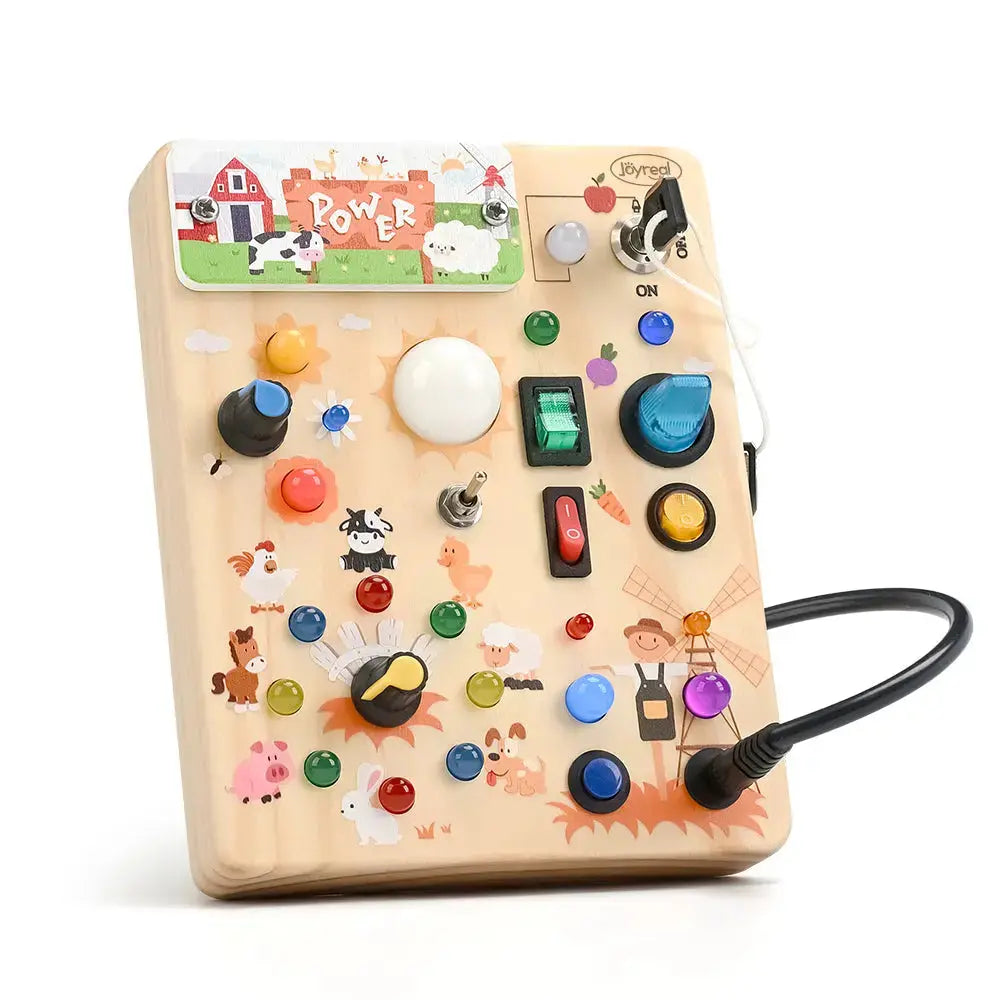
Sunny Farm LED Busy Board
- Dimensions: 5.91 × 3.15 × 0.98 inches
- Recommended age: 18 months and up
- Activities: 10 light switches, rotary dials, a key switch, toggle switches, buttons, and a pluggable wire
- Power: Requires 2 AAA batteries
The board has a compact wooden design, but there's still plenty for little hands to explore. Children can flip switches, turn dials, and press buttons, exploring the different controls and light-up features along the way.
To picture its size more easily, imagine placing it on a standard sheet of A4 paper (8.27 × 11.69 inches). Its front face measures 5.91 × 3.15 inches, making it much smaller than the sheet of paper. This gives you a more practical idea of its size than the product photos alone.
This example also shows why it's worth looking beyond the size label. Even a compact busy board can offer several different activities. Its recommended age gives you an idea of the intended age range, while the battery information tells you what you'll need to power the lights.
If you'd like to see how other designs compare, you can browse the Joyreal busy board collection.
A Final Note
Some of the sweetest play moments start with a little discovery—a switch that lights up, a latch that opens, or a knob that turns. A busy board gives curious little hands plenty to explore at their own pace.
Frequently Asked Questions
How Do I Choose the Right Busy Board Size for My Child?
Think about where your child will use the busy board most often and how much space you have available. A mini or small board can be easier to store and take on outings, while a larger board may suit a dedicated play area at home. Always check the actual dimensions rather than relying on size labels alone, as sizing can vary between brands.
Do Foldable Busy Boards Need Extra Storage Space?
Foldable busy boards are designed to take up less room when they're not in use, but it's still worth checking their folded dimensions. Make sure you have a suitable place to store the board, and consider its weight and carrying features if you plan to move it around regularly.
What Age Is a Busy Board Suitable For?
Busy boards are available for different age groups, depending on their activities and design. Check the manufacturer's recommended age range before choosing one, and consider whether the activities are suitable for your child's current stage. Always follow the product's safety instructions and supervise young children during play.


Guides populaires pour les parents
- Table d’activités DIY : guide pour fabriquer la vôtre
- Jouets en bois Montessori : choisissez des jouets d’éveil à la marche pour stimuler les premières compétences de bébé
- Panneaux d’activités Montessori par âge : des jouets sûrs pour développer les compétences des enfants de 10 mois à 4 ans
- Comment les différentes couleurs affectent-elles la surcharge sensorielle chez les enfants autistes ?
- L’arche de Noé : développer ses compétences en jouant
- Les meilleurs tableaux d’activités pour les enfants d’un an : guide des parents pour les jeux sensoriels
Article récent

How to Choose Silicone Teething Toys: Material, Shape, Texture & Care
Your baby has started chewing on sleeves, rattles, and anything ...

Newborn Teething Toys: How to Choose for a 3- or 4-Month-Old
Your baby has started chewing on their hands and drooling more t...

Busy Board vs. Busy Book: Which Is Better for your Toddler?
Looking for a screen-free toy that gives your toddler’s hands s...

Busy Board Not Working? Common Problems with Buttons, Lights & Switches
The light won’t turn on, a button doesn’t respond, or a switc...

How to Choose a Durable Busy Board: What Should Check Before Buying
Shopping for a busy board for your little one? With curious han...

Busy Board Sizes, Shapes & Setups Explained: A Guide to Common Types
Ever found a busy board that looks just right, then paused when y...

Is an LED Busy Board Right for Your Child? What to Consider Before Buying
If you're thinking about getting an LED busy board for your littl...

Best Christmas Gift Guide for 1-Year-Olds: Montessori Busy Boards
Christmas is coming, and you've got a one-year-old on your gift li...

Jouets musicaux en bois ou jouets musicaux électroniques : lesquels sont les meilleurs pour le jeu libre ?
Pour les parents qui souhaitent un environnement de jeu plus calme...

10 jeux musicaux simples parent-enfant avec une batterie pour tout-petit
Un tambour pour tout-petit peut devenir bien plus qu'un jouet bruya...