
How to Choose the Right AAC Device for an Autistic Children
Choosing an AAC device for an autistic child can feel overwhelming. Families may encounter picture cards, communication boards, single-message buttons, tablet apps, and speech-generating devices—but no single option works for every child.
The best AAC device is not necessarily the most advanced or expensive option. It is the system the child can access, understand, and use meaningfully across everyday situations.

AAC Device vs. AAC System
An AAC device is one part of a broader AAC system. An AAC system may include a speech-generating device, communication board, picture cards, gestures, signs, or other communication methods.
A child may use more than one communication method depending on the situation. For example, a speech-generating device may be used as the primary system at home, while a printed communication board or picture cards provide a backup during school, travel, or outdoor activities.
The goal is not to choose one tool for every situation. The goal is to make sure the child has reliable access to communication wherever and whenever it is needed.
AAC may support children who are nonspeaking, minimally speaking, speech-delayed, or able to speak in some situations but not reliably in others. Children do not need to wait until they are completely nonspeaking, reach a certain age, or receive a formal autism diagnosis before exploring AAC.
What Should an AAC System Help a Child Communicate?
AAC should support more than requesting toys or food.
Children may also need to communicate:
-
No or “I do not want that”
-
Stop
-
Help
-
I need a break
-
I feel sick
-
I am hurt
-
My turn
-
I want to join
-
I like this
-
I do not like this
-
What is that?
-
I have an idea
When comparing devices, ask whether the system can support these types of messages. A tool with only a few requesting buttons may be useful for a specific activity, but it may not meet a child’s broader communication needs.
AAC Device Comparison
Different AAC options serve different purposes.
| AAC option | Main benefits | Possible limitations | Common use cases |
|---|---|---|---|
| Gestures and signs | Always available and does not require equipment | Communication partners may not understand every sign | Familiar routines and quick responses |
| Picture cards | Simple, affordable, and easy to introduce | Vocabulary may be limited; abstract messages can be difficult | Choices, requesting, and routines |
| Communication boards or books | Organize multiple pictures and words in one place | May be harder to carry, update, or protect | Home, school, therapy, and community activities |
| Single-message buttons | Easy to activate and useful for repeated messages | Usually supports only one message at a time | “More,” “go,” “help,” “stop,” or turn-taking |
| Recordable communication devices | Portable and can provide spoken messages | Message options may remain limited | Play, transitions, and simple routines |
| AAC tablet apps | Flexible vocabulary, pictures, text, and speech output | Require charging, setup, maintenance, and consistent modeling | Children who need broader communication |
| Speech-generating devices | Designed for complex and ongoing communication needs | May require professional assessment and a longer learning process | School, home, social interaction, and independence |
Looking for a Simple AAC Starting Point?
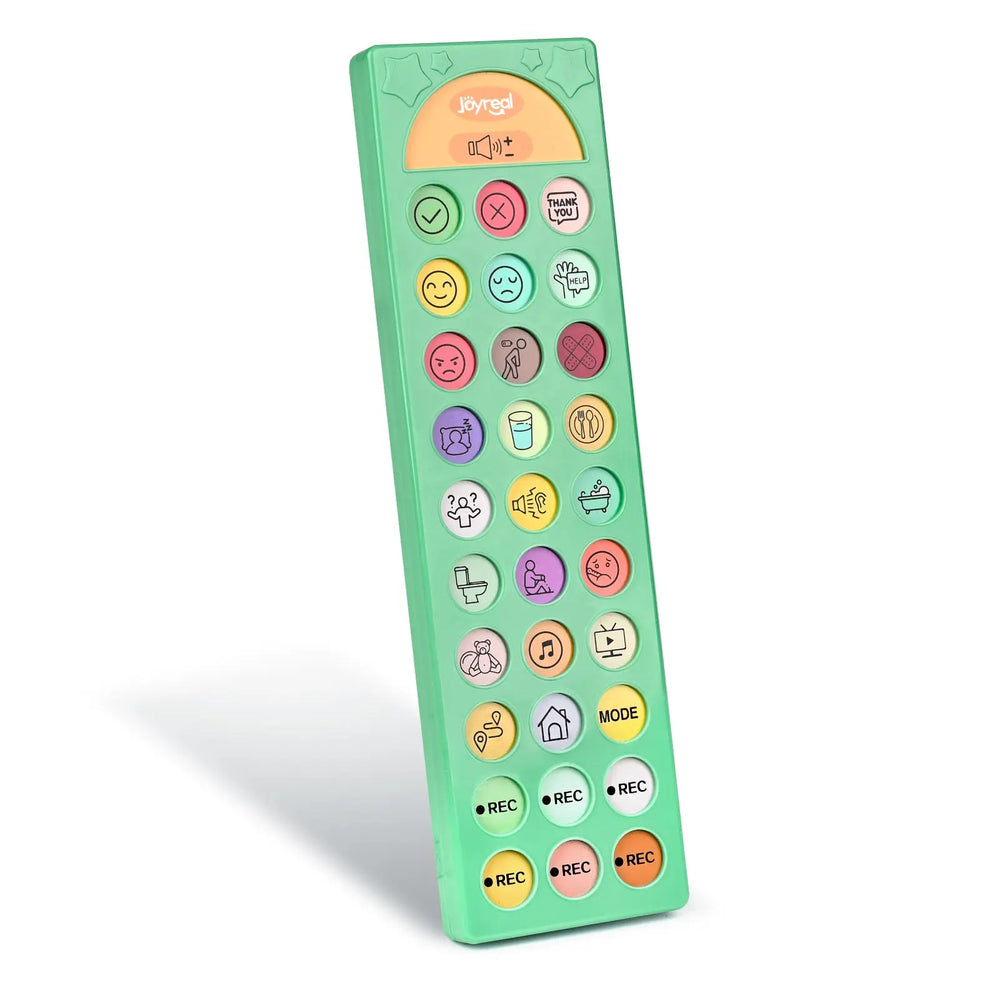
Families who are beginning to explore AAC may prefer a portable tool with clear buttons and familiar voice-output messages. A simple device can be useful for practicing high-frequency communication such as “more,” “help,” “stop,” “go,” or “all done.”
A simple AAC tool may be used alongside picture cards, gestures, signs, spoken language, or a more comprehensive AAC system. It is not intended to meet every communication need for every child.
Explore Joyreal’s Talking Aid AAC Tools

Step 1: Identify the Communication Need
Start with real situations rather than device features.
Ask:
-
What does my child try to communicate?
-
When is communication most difficult?
-
Is frustration happening during requests, refusals, transitions, or social interaction?
-
Does my child need to express pain, discomfort, or the need for a break?
-
Does my child need a larger vocabulary or only a few repeated messages?
Write down examples such as:
-
“I want more.”
-
“Help me open this.”
-
“No, I do not want that.”
-
“Stop.”
-
“I need a break.”
-
“I feel uncomfortable.”
-
“I want to play.”
These examples can help families and professionals identify the right vocabulary and communication features.
Step 2: Consider How the Child Accesses Information
An AAC system must match the child’s physical, visual, hearing, and sensory abilities.
Observe whether your child can:
-
Point to pictures or objects
-
Press large buttons
-
Touch a screen accurately
-
Look toward a preferred item
-
Use eye gaze
-
Turn pages
-
Match pictures
-
Use gestures or signs
-
Hear and respond to recorded speech
-
Maintain attention to a visual display
Consider the size and spacing of buttons, screen sensitivity, contrast, sound volume, mounting position, and access method.
A device may appear powerful, but it will not be useful if the child cannot comfortably access it.
Step 3: Compare Low-Tech and High-Tech Options
A low-tech system, such as picture cards or a communication board, may be a useful starting point when a child is exploring AAC or needs support for a small number of daily messages.
A single-message button may be helpful when a child benefits from a simple cause-and-effect interaction. It can support repeated messages such as “more,” “go,” “again,” or “stop.”
A tablet-based AAC app or speech-generating device may be more appropriate when a child needs:
-
A larger vocabulary
-
Sentence building
-
Social communication
-
Questions and comments
-
More independent message creation
-
Communication across multiple environments
The simplest option is not always the best option. The level of complexity should match a clear communication purpose.
Step 4: Check Vocabulary Flexibility
A useful AAC system should grow with the child.
Look for vocabulary that supports:
-
Requesting
-
Rejecting
-
Commenting
-
Asking questions
-
Getting attention
-
Describing feelings
-
Communicating pain
-
Talking about people and activities
-
Taking turns
-
Asking for a break
Core words such as “more,” “help,” “stop,” “go,” “open,” “different,” “like,” “not like,” and “finished” can be used across many routines.
Also consider whether caregivers can add:
-
Names of family members
-
Favorite activities
-
School vocabulary
-
Medical or safety messages
-
Social phrases
-
Words related to the child’s interests
A system that only allows a child to request preferred items may not provide enough flexibility for long-term communication.
Step 5: Consider Portability and Durability
Children may need AAC at home, school, therapy, restaurants, playgrounds, and community activities.
Before choosing a device, consider:
-
Can it be carried easily?
-
Does it need charging?
-
Can it be protected during active play?
-
Can it be mounted to a wheelchair, table, or stroller if needed?
-
Is it easy for caregivers to maintain?
-
Can the child use it in noisy or busy environments?
-
Is there a backup if it is lost, damaged, or uncharged?
A printed board or picture-card set can provide an important backup for an electronic system.
Step 6: Test the Tool in Real Routines
A demonstration in a store or therapy room may not show how well a system works in daily life.
Try the tool during activities such as:
-
Play
-
Meals
-
Getting dressed
-
Bath time
-
Reading
-
Transitions
-
Travel
-
Leaving the house
-
School routines
Watch for:
-
Whether the child can access it independently
-
Whether the child understands what happens after using it
-
Whether adults can model it easily
-
Whether it is portable enough for daily use
-
Whether it remains useful outside the home
-
Whether the child appears comfortable using it
A short real-life trial can reveal important practical issues.
For families who want to try a compact communication tool during familiar routines, a portable voice-output device may be considered for play, meals, transitions, travel, and community outings.
A small device can give a child quick access to a few meaningful messages without requiring them to navigate multiple pages or screens.
See a Simple Voice-Output AAC Device for Everyday
Step 7: Plan for Support and Future Growth
AAC is not a one-time purchase. A child’s communication system may change as their motor skills, language, preferences, environments, and goals develop.
Consider:
-
Can caregivers add or change vocabulary?
-
Can the device support more complex messages later?
-
Can multiple communication partners learn to use it?
-
Is training available?
-
Can the system be repaired or updated?
-
Will it work across home, school, and community settings?
Parents should also keep the system available throughout the day, not only during therapy. Adults can model words and symbols naturally without requiring the child to imitate them.
Avoid taking the communication device away as punishment. Avoid requiring the child to repeat a message before receiving help, comfort, food, or access to an activity.
A simpler device may be easier to access in some situations, but it may not provide enough vocabulary for every child or meet long-term communication needs. Families may use it as a starting point, a backup tool, or one part of a broader AAC system.
When to Seek Professional Guidance
A speech-language pathologist or AAC specialist can help families evaluate:
-
Motor access
-
Vision and hearing
-
Language comprehension
-
Sensory needs
-
Vocabulary requirements
-
Communication environments
-
Device features
-
Access methods
-
Communication-partner training
Professional guidance is especially important when a child has complex communication needs, difficulty accessing a device, or needs communication support across several environments.
An individualized assessment does not mean families must wait before offering communication support. Low-tech tools, gestures, signs, and visual choices can often be used while a more comprehensive system is being explored.
Explore AAC Tools for Everyday Routines
Every child may need a different combination of communication supports. Some families begin with a simple voice-output tool, while others use communication boards, picture cards, or a more comprehensive AAC system.
If you are looking for a portable option for familiar messages, explore Joyreal’s AAC communication tools and choose an option that matches your child’s current access needs.
Explore Joyreal AAC Communication Tools

Frequently Asked Questions
What is the difference between an AAC device and an AAC system?
An AAC device is one tool used to support communication, such as a speech-generating device, tablet app, or voice-output button. An AAC system is broader and may include devices, picture cards, communication boards, gestures, signs, and spoken language.
What is the best AAC device for an autistic child?
There is no single best AAC device for every autistic child. The right option depends on the child’s communication goals, motor skills, sensory preferences, access method, vocabulary needs, and everyday environments.
Should a child start with a simple AAC device?
A simple AAC device may be a useful starting point when a child needs quick access to a small number of familiar messages or finds larger systems difficult to navigate.
However, a simple tool may not provide enough vocabulary for children who need sentence building, questions, comments, or more complex communication. It may be used alongside a broader AAC system.
Can a child use more than one AAC device or communication method?
Yes. A child may use a speech-generating device at home, a printed communication board at school, picture cards during routines, and gestures or signs throughout the day.
Using multiple communication methods can help maintain access when one tool is unavailable, uncharged, or difficult to use.
Does using an AAC device prevent a child from speaking?
Current evidence does not show that AAC prevents speech development. AAC can supplement spoken communication or provide an alternative when speech is delayed, unreliable, or unavailable.
It gives children another way to express needs, choices, feelings, ideas, and social messages.
Final Thoughts
Choosing an AAC device for an autistic child is a process of matching the communication system to the child—not choosing the most expensive or advanced technology.
Focus on access, flexibility, portability, durability, vocabulary, and real-life use. Make sure the child can communicate more than requests, including refusals, feelings, pain, questions, social messages, and the need for help.
The right AAC system should make communication easier and more independent. It should never make a child feel pressured to perform.
Families can review the American Speech-Language-Hearing Association’s guidance on Augmentative and Alternative Communication and seek individualized support from a qualified speech-language pathologist or AAC specialist.
This article is for general educational purposes and is not a substitute for an individualized assessment by a qualified professional.


Popular Guides for Parents
- DIY Busy Board: A Guide to Making Your Own
- Montessori Wooden Toys: Choose Baby Walking Toys to Boost Early Skills
- Montessori Busy Boards by Age: Safe, Skill-Building Toys for 10 Months to 4 Years
- How Do Different Colors Affect Sensory Overload in Autistic Children?
- Noah’s Ark Toy: Building Skills Through Play
- Best Busy Boards for 1 Year Old: A Parent’s Guide to Sensory Play
Recent Post

Wooden Musical Toys vs Electronic Music Toys: Which Is Better for Open-Ended Play?
For parents who want a calmer play environment, the choice between...

10 Simple Parent-Child Music Games Using a Toddler Drum Set
A toddler drum set can become much more than a noisy toy. With a fe...

Noah’s Ark Activities for Sunday School and Preschool
A Noah’s Ark toy can turn a familiar Bible story into a hands-on ac...

Noah’s Ark Toy Gift Guide: What Should Parents Check Before Buying?
A noah’s ark toy can be a thoughtful birthday, baptism, Christmas, ...

Can a Noah’s Ark Toy Be Used for Science and Nature Play?
Yes. A noah’s ark toy can be used as a starting point for simple sc...

How Can AAC Help a Child Communicate Pain, Illness, or Discomfort?
A child who cannot reliably use speech may still notice pain, illne...

How to Model AAC During Play Without Pressuring Your Child
For many children, play is one of the most comfortable places to pr...

How Can Parents Help a Child Use AAC at School and Home?
How Can Parents Help a Child Use AAC at School and Home? Children w...

AAC for Siblings and Playdates: Helping Children Join Social Play
Children do not need to use speech to take part in sibling play or ...

How to Teach Independent Play With a Busy Board Without Overhelping
Independent play does not usually begin with a parent stepping away...