
Busy Board or Communication Device? A Joyreal Guide for Autistic Toddlers
One Question Every Autism Parent Asks
Every autism parent faces this question sooner or later:
“Should I buy a busy board or a communication device for my child?”
Both seem helpful, both are called “autism-friendly,” and both promise developmental progress.
But here’s the truth — they serve very different purposes.
- A busy board for toddlers focuses on motor skills, cause and effect, and independence.
- A communication device for non verbal autism focuses on language understanding, emotional expression, and social connection.
They are not alternatives.
They are complements — two sides of your child’s developmental journey.

Understanding the Difference: Same Autism Support, Different Goals
1. What Is a Busy Board?
A busy board (also called a montessori busy board for toddlers) is a hands-on, sensory-based educational toy designed to encourage exploration and independent learning.
It includes elements like zippers, buttons, switches, locks, and gears — all in one interactive panel.
For children on the autism spectrum, this kind of tactile learning is crucial. It helps them connect with their environment through action and sensory feedback.
Key Benefits of Busy Boards
- Fine Motor Skills: Improves finger strength and hand-eye coordination.
- Cause and Effect Understanding: Teaches that actions lead to outcomes (“If I flip this switch, the light turns on”).
- Independence and Focus: Builds patience, attention span, and confidence.
The Joyreal busy board is specifically designed for autistic toddlers and sensory learners — blending Montessori philosophy with autism-friendly textures and interactions.

2. What Is a Communication Device?
A communication device for non verbal autism (often called an AAC device, or Augmentative and Alternative Communication device) helps non-verbal or minimally verbal children express their thoughts, needs, and emotions.
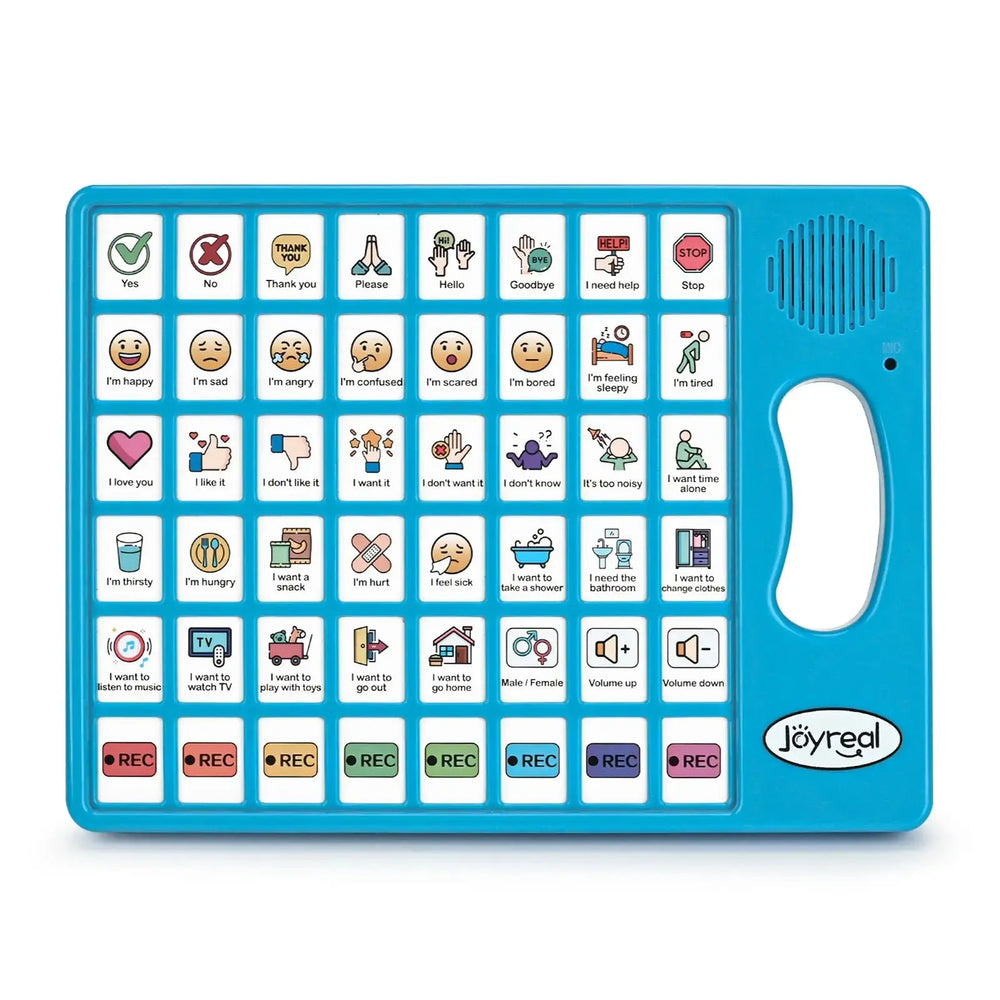
The Joyreal AAC is a communication tool that uses images, sounds, or voice outputs to support language understanding and emotional expression.
These devices help children:
- Express needs (“I want juice”)
- Recognize feelings (“I’m sad”)
- Engage socially with caregivers and peers
Core Benefits of AAC Devices:
- Improves Speech and Language Comprehension
- Reduces Frustration and Tantrums
- Builds Emotional Awareness and Confidence
💬 A communication device doesn’t replace speech — it supports it.
For many autistic children, Joyreal AAC is their first real “voice.”

Why Parents Confuse the Two
Many autism parents assume both tools have the same goal: helping the child communicate.
However, the path to communication begins long before speech.
A toddler must first:
- Learn to control their hands and body (via sensory play).
- Understand cause and effect.
- Recognize emotions and patterns.
- Then, express those emotions through words or devices.
That’s why a montessori busy board for toddlers lays the foundation that AAC communication devices later build upon.
How They Work Together: The Perfect Autism Support Duo
| Aspect | Busy Board | Communication Device |
| Focus | Motor Skills, Exploration | Communication, Emotional Awareness |
| Learning Type | Hands-on Sensory | Visual & Auditory |
| Key Goal | I can do things | “I can express things” |
| Ideal Age | 1–4 years old | 2+ years old |
| Example Product | Joyreal Busy Board | Joyreal AAC Device |
Busy Board Builds the Foundation
Imagine your child flipping a switch on their Joyreal busy board — the light turns on.
They smile, realizing, “I made that happen!”
This spark of agency is the beginning of all learning.
Over time, sensory play strengthens attention, coordination, and curiosity — all critical prerequisites for communication.
AAC Device Builds the Expression
Now that your child understands cause and effect, they’re ready to express cause and emotion.
The Joyreal AAC gives them the tools to say “I’m happy,” “I want that,” or even “No.”
It teaches that communication has power — just like flipping that light switch did.
Together, the two tools create a complete learning loop:
Busy Board → Builds Understanding → AAC → Builds Expression

Choosing the Right Tool for Your Child
1. When to Start with a Busy Board
Choose a Montessori busy board for toddlers if your child:
- Enjoys sensory exploration (lights, textures, switches)
- Has limited attention span
- Isn’t yet motivated to communicate
- Needs help with fine motor control
A Joyreal busy board encourages self-discovery — essential for building confidence and curiosity.
2. When to Introduce a Communication Device
Choose a communication device for non verbal autism if your child:
- Understands simple instructions but doesn’t respond
- Gets frustrated when unable to express wants
- Has developed cause-and-effect understanding
- Shows emotional reactions (smiles, cries) but not verbal output
In this case, Joyreal AAC provides the next step — turning understanding into expression.
The Science Behind the Sequence
According to research from Autism Speaks and The American Speech-Language-Hearing Association (ASHA), communication development in autistic children follows three stages:
- Sensory Learning — Understanding the world through touch and movement.
- Symbolic Learning — Recognizing that words and images represent objects or feelings.
- Social Communication — Using those symbols to connect with others.
A montessori toy for 2 year old like the Joyreal busy board targets Stage 1,
while an autism communication device like Joyreal AAC supports Stages 2 and 3.
In other words, the busy board builds the “input system,”
and the communication device builds the “output system.”
Common Mistakes Parents Make (And How to Avoid Them)
| Mistake | Reality | Solution |
| My child isn’t talking, so we only use an AAC device | Without sensory foundation, AAC can feel abstract. | Combine Joyreal AAC with sensory play like the Joyreal busy board. |
| Busy boards are too basic for older toddlers | Repetition builds confidence and focus. | Use advanced panels or switch to Montessori versions. |
| AAC will stop my child from talking. | Research shows the opposite — it encourages speech. | Encourage vocal sounds while using AAC. |
| “I’ll buy lots of toys to stimulate progress.” | Quality over quantity. | Select one montessori busy board for toddlers and one AAC device, and use them consistently. |
Real Parent Experiences
“My son started with the Joyreal busy board at age two. It was the only toy that kept him focused for more than 10 minutes. A few months later, we added the Joyreal AAC — now he taps ‘juice’ or ‘happy’ on the device. It feels like he finally found his voice.”
— Amy, mom of a 3-year-old with ASD
“We used to think communication devices were too advanced for our daughter. But once she mastered her Montessori busy board, she quickly grasped how to use the AAC. They truly complement each other.”
— Liam, dad of a 4-year-old
Why Joyreal?
Joyreal isn’t just a toy brand — it’s a developmental system grounded in Montessori principles and autism therapy research.
The Joyreal Busy Board promotes independent learning and focus.
- The Joyreal AAC Communication Device encourages expression, empathy, and connection.
- Together, they form a complete autism development ecosystem for toddlers and preschoolers.
Together, they form a complete autism development ecosystem for toddlers and preschoolers.
- ✨ From understanding the world to expressing the self, Joyreal bridges both sides of learning.

Conclusion: Building Bridges, Not Walls
For autistic children, learning doesn’t happen linearly — it happens through connection.
A busy board helps them understand the world;
an AAC communication device helps them express their world.
When combined, they create the perfect bridge between independence and interaction.
- 💙 With Joyreal, your child doesn’t just play — they grow, learn, and connect.
FAQ
Q1: Is the Joyreal busy board safe for toddlers?
- Absolutely. It’s built from non-toxic, smooth wood with rounded edges — perfect as a Montessori toy for 2 year old and above.
Q2: Can the Joyreal AAC help my non-verbal child start speaking?
- Yes. Studies show that AAC communication devices actually encourage speech by reducing frustration and improving understanding.
Q3: Should I buy both products at once?
- If possible, yes. They target different skills — sensory input and expressive output — making them a powerful combination.
Q4: My child ignores the AAC. What should I do?
- Use it during natural routines (mealtime, playtime). Pair actions from the busy board for toddlers with words on the AAC to build association.
Q5: How long before I see results?
- Consistency is key. Many parents report progress in 4–6 weeks with daily 10–15 minute sessions.
Q6: Are these tools suitable for older kids?
- Yes. Both Joyreal busy board and Joyreal AAC can be adapted for preschoolers and even school-age children needing sensory and communication support.


Popular Guides for Parents
- DIY Busy Board: A Guide to Making Your Own
- Montessori Wooden Toys: Choose Baby Walking Toys to Boost Early Skills
- Montessori Busy Boards by Age: Safe, Skill-Building Toys for 10 Months to 4 Years
- How Do Different Colors Affect Sensory Overload in Autistic Children?
- Noah’s Ark Toy: Building Skills Through Play
- Best Busy Boards for 1 Year Old: A Parent’s Guide to Sensory Play
Recent Post

Wooden Musical Toys vs Electronic Music Toys: Which Is Better for Open-Ended Play?
For parents who want a calmer play environment, the choice between...

10 Simple Parent-Child Music Games Using a Toddler Drum Set
A toddler drum set can become much more than a noisy toy. With a fe...

Noah’s Ark Activities for Sunday School and Preschool
A Noah’s Ark toy can turn a familiar Bible story into a hands-on ac...

Noah’s Ark Toy Gift Guide: What Should Parents Check Before Buying?
A noah’s ark toy can be a thoughtful birthday, baptism, Christmas, ...

Can a Noah’s Ark Toy Be Used for Science and Nature Play?
Yes. A noah’s ark toy can be used as a starting point for simple sc...

How Can AAC Help a Child Communicate Pain, Illness, or Discomfort?
A child who cannot reliably use speech may still notice pain, illne...

How to Model AAC During Play Without Pressuring Your Child
For many children, play is one of the most comfortable places to pr...

How Can Parents Help a Child Use AAC at School and Home?
How Can Parents Help a Child Use AAC at School and Home? Children w...

AAC for Siblings and Playdates: Helping Children Join Social Play
Children do not need to use speech to take part in sibling play or ...

How to Teach Independent Play With a Busy Board Without Overhelping
Independent play does not usually begin with a parent stepping away...