


Early Signs Of Autism In Toddlers: Speech Delay, Sensory Needs, And Social Differences
When “Late Talking” Starts To Feel Like Something More
Your toddler hears the sound of their favorite cartoon from another room, but does not always respond when you call their name.
They pull your hand to the fridge instead of saying “milk.”
They cry when you cannot understand what they want.
They cover their ears in busy places.
They refuse certain clothes, foods, or textures.
They line up toys, spin wheels, or repeat the same activity again and again.
At first, these moments may seem small. Toddlers develop at different speeds, and not every delay means autism. But when speech delay, sensory needs, and social differences appear together, many parents begin to wonder:
Is this just a speech delay, or could it be an early sign of autism?
This article is for parents who are noticing patterns and want a clear, gentle place to start. It is for educational purposes only and does not replace advice from a pediatrician, developmental specialist, or speech-language pathologist.

What Are The Early Signs Of Autism In Toddlers?
Autism spectrum disorder is a developmental difference that can affect social communication, behavior, interests, play, routines, and sensory processing. The CDC describes autism as often involving differences in social communication and interaction, along with restricted or repetitive behaviors or interests. These may include delayed language, unusual sensory reactions, repetitive movements, distress with changes, or intense interests.
Autism looks different in every toddler. Some children are nonverbal. Some use a few words. Some talk but do not use language socially. Some seek sensory input, while others avoid it. Some are very affectionate at home but struggle with name response, gestures, shared attention, or transitions.
That is why parents should not focus on one single sign. It is more helpful to look at the whole pattern.
Speech Delay: One Of The First Signs Parents Notice
Speech delay is often the first reason parents search for autism signs in toddlers.
A toddler may have very few words, stop using words they once had, repeat sounds or phrases, or seem to understand more than they can say. Some toddlers do not use words to request help, food, toys, comfort, or a break. Instead, they may pull an adult’s hand, point, cry, scream, grab, or become upset.
Parents may notice:
- Few or no spoken words by age 2 or 3
- Not combining words into simple phrases
- Not using words to ask for help or make choices
- Pulling adults toward objects instead of asking
- Repeating words without using them meaningfully
- Getting frustrated when needs are not understood
- Losing words or communication skills they once used
By age 2, the CDC lists language and communication milestones such as saying at least two words together, pointing to things in a book when asked, pointing to body parts, and using gestures beyond waving or pointing. By age 3, the CDC lists milestones such as using at least two back-and-forth exchanges, asking simple “who,” “what,” “where,” or “why” questions, saying a first name, and talking well enough for others to understand most of the time.
Speech delay alone does not always mean autism. Some toddlers are late talkers. Some may have hearing concerns, oral-motor challenges, language delay, or other developmental differences. But when speech delay appears together with limited gestures, reduced social response, repetitive play, or strong sensory reactions, it is worth asking for a developmental screening.
Speech Delay Vs. Autism: How Parents Can Tell The Difference
Many parents quietly ask the same question:
Can my toddler have speech delay but not autism?
Yes, they can. Speech delay and autism can overlap, but they are not the same.
A toddler with speech delay may still point to show something interesting, bring toys to share, copy actions, enjoy back-and-forth play, respond to their name, and use gestures to communicate.
A toddler showing signs of autism may also have speech delay, but parents may notice additional differences in social interaction, sensory processing, repetitive behaviors, routines, or play.
Instead of only asking, “Is my child talking?” parents can ask:
Does my child respond to their name most of the time?
Do they point to show me something interesting, not only to request?
Do they copy my sounds, gestures, or actions?
Do they bring toys to share with me?
Do they look back and forth between me and an object?
Do they use gestures like waving, nodding, reaching, or showing?
Do they become overwhelmed by sounds, textures, lights, or transitions?
Do they play with toys in flexible ways, or repeat the same action again and again?
If several answers raise concern, it may be time to speak with a pediatrician or request an early evaluation.
Social Differences: Name Response, Eye Contact, And Shared Attention
Some early signs of autism are not about speech alone. They are about how a toddler connects with people.
A child may not respond consistently when their name is called. They may not look where a parent points. They may not bring objects to show an adult. They may not copy facial expressions, wave goodbye, or join simple social games like peekaboo.
The CDC lists social communication signs such as not responding to name, avoiding or not keeping eye contact, using few gestures, and not sharing interests with others as possible autism-related signs.
At home, social differences may look like:
- Not responding to name, even when hearing seems normal
- Limited eye contact during interaction
- Not pointing to show interesting things
- Not bringing toys to share
- Not looking where a caregiver points
- Limited back-and-forth play
- Less imitation of gestures, sounds, or facial expressions
- Preference for playing alone
- Difficulty joining simple social games
This does not mean the child is ignoring you on purpose. It may mean their social communication is developing differently.
Sensory Needs: Sounds, Textures, Food, Clothing, And Transitions
Sensory needs are another common pattern parents notice early.
Some toddlers are highly sensitive to sound, light, touch, smell, taste, or movement. Others seek sensory input by jumping, spinning, chewing, crashing into cushions, or watching moving objects closely.
The CDC includes unusual reactions to the way things sound, smell, taste, look, or feel among autism-related characteristics.
Sensory signs may look like:
- Covering ears during everyday sounds
- Crying during haircuts, toothbrushing, or nail trimming
- Refusing socks, tags, shoes, or certain fabrics
- Strong reactions to food textures or smells
- Avoiding messy play, grass, sand, or finger paint
- Watching spinning wheels, fans, lights, or moving objects
- Seeking deep pressure, climbing, jumping, or crashing
- Becoming overwhelmed in busy stores or noisy rooms
- Having a hard time calming after sensory overload
For some toddlers, what looks like a tantrum may actually be sensory overwhelm. A child may not have the words to say, “It’s too loud,” “This hurts,” “I don’t like that texture,” or “I need a break.”
That is why behavior should be viewed as communication, especially when a child has limited speech.
Repetitive Play And Strong Routines
Repetition is normal in toddlerhood. Many children love reading the same book, singing the same song, or playing the same game again and again.
But parents may want to pay attention when play becomes very rigid, repetitive, or difficult to interrupt.
Autistic toddlers may line up cars, spin wheels, open and close doors, sort objects, repeat movements, or become upset when the order changes. They may focus more on parts of a toy than the whole toy.
Parents may notice:
- Lining up toys repeatedly
- Spinning wheels instead of playing with the full toy
- Opening and closing doors or containers again and again
- Repeating the same movement or sound
- Becoming upset when toys are moved
- Needing routines to happen in the same order
- Strong distress with transitions
- Intense interest in one object or activity
- Repetitive movements such as hand flapping, rocking, or spinning
These behaviors may help a child feel calm or regulated. The goal is not to shame the behavior. The goal is to notice whether it appears alongside communication delays, social differences, or sensory needs.
Big Emotions May Be Communication
Many toddlers have tantrums. But for toddlers with speech delay, sensory overload, or autism-related communication differences, big emotions may happen more often because the child cannot express what they need.
A toddler may cry because they cannot say “help.”
They may scream because they cannot say “stop.”
They may throw a toy because they cannot ask for “more.”
They may collapse during a transition because they do not understand what is happening next.
They may become upset at mealtime because the smell, texture, or sound feels overwhelming.
These moments are not always “bad behavior.” Sometimes they are communication without words.
When a child does not yet have reliable speech, parents can support them with simple language, predictable routines, visual cues, and communication tools.
Quick Parent Checklist: Signs Worth Watching
Use this checklist as a gentle observation tool, not a diagnosis.
Ask yourself:
- Does my toddler respond to their name most of the time?
- Do they point to show me something interesting?
- Do they bring toys or objects to share, not only to request help?
- Do they use gestures like waving, nodding, reaching, or showing?
- Do they copy sounds, faces, or simple actions?
- Do they use words, signs, or pictures to ask for help, more, stop, or all done?
- Do they react strongly to sounds, textures, lights, food, clothing, or changes?
- Do they play with toys in flexible ways?
- Do they become very upset during transitions or changes in routine?
- Do they seem to understand more than they can express?
If several of these feel familiar, it may be helpful to speak with a professional. You do not need to wait until every sign is present.
When Should Parents Seek Autism Screening?
Parents should talk with a pediatrician if they notice speech delay, loss of skills, limited gestures, reduced social response, strong sensory reactions, repetitive behaviors, or any developmental concern.
The American Academy of Pediatrics recommends autism-specific screening at 18 and 24 months, along with regular developmental surveillance. The CDC also states that children should be screened specifically for autism spectrum disorder during well-child doctor visits at 18 months and 24 months.
Parents can ask about:
- Developmental screening
- Hearing testing
- Speech-language evaluation
- Early intervention services
- Autism evaluation, if recommended
Getting support early does not mean labeling your child too soon. It means giving your child more chances to communicate, connect, and grow.
How Parents Can Support Communication At Home
While waiting for appointments or evaluations, parents can begin supporting communication in everyday routines.
Helpful strategies include:
- Use short, clear phrases
- Name what your child wants or feels
- Offer simple choices
- Use gestures, pictures, or visual routines
- Pause and give your child time to respond
- Follow your child’s interests during play
- Model useful words like “more,” “help,” “stop,” “go,” and “all done”
- Reduce pressure to “say it”
- Notice sensory triggers and offer breaks
For toddlers who are nonverbal, minimally verbal, or frustrated by speech delay, AAC may also be part of early communication support.
ASHA defines AAC as a clinical area that supplements or compensates for impairments in speech-language production or understanding, using tools such as gestures, picture boards, and speech-generating devices. ASHA’s early intervention guidance also states that there is no “too young” age for AAC and that AAC can be introduced when a child shows difficulty developing spoken communication.
This is why some families begin looking for an aac communication device, especially when their toddler has daily needs but no reliable way to express them.

Where AAC Communication Tools Can Fit
AAC does not mean giving up on speech. It gives a child another way to communicate while speech and language continue developing.
Some children use picture cards. Some use communication boards. Some use speech-generating buttons. Some use apps or tablets. Some families start with simple tools at home before moving into a more complex system with professional guidance.
For autistic toddlers, aac devices for autism or communication devices for autism can help make everyday communication more concrete and predictable. A child may use a device to request a favorite toy, say “no,” ask for help, express discomfort, or choose between activities.
For toddlers with speech delay, aac devices for speech can help bridge the gap between what a child understands and what they can say. A child may not be able to say “I need help,” but they may be able to press, point, or select a symbol that helps a parent understand.
For families searching for a communication device for non verbal toddlers, the best starting point is usually something simple, consistent, and easy to use during real routines.
The first goal is not to give a child every possible word. The first goal is to help them experience this powerful idea:
When I communicate, someone understands me.
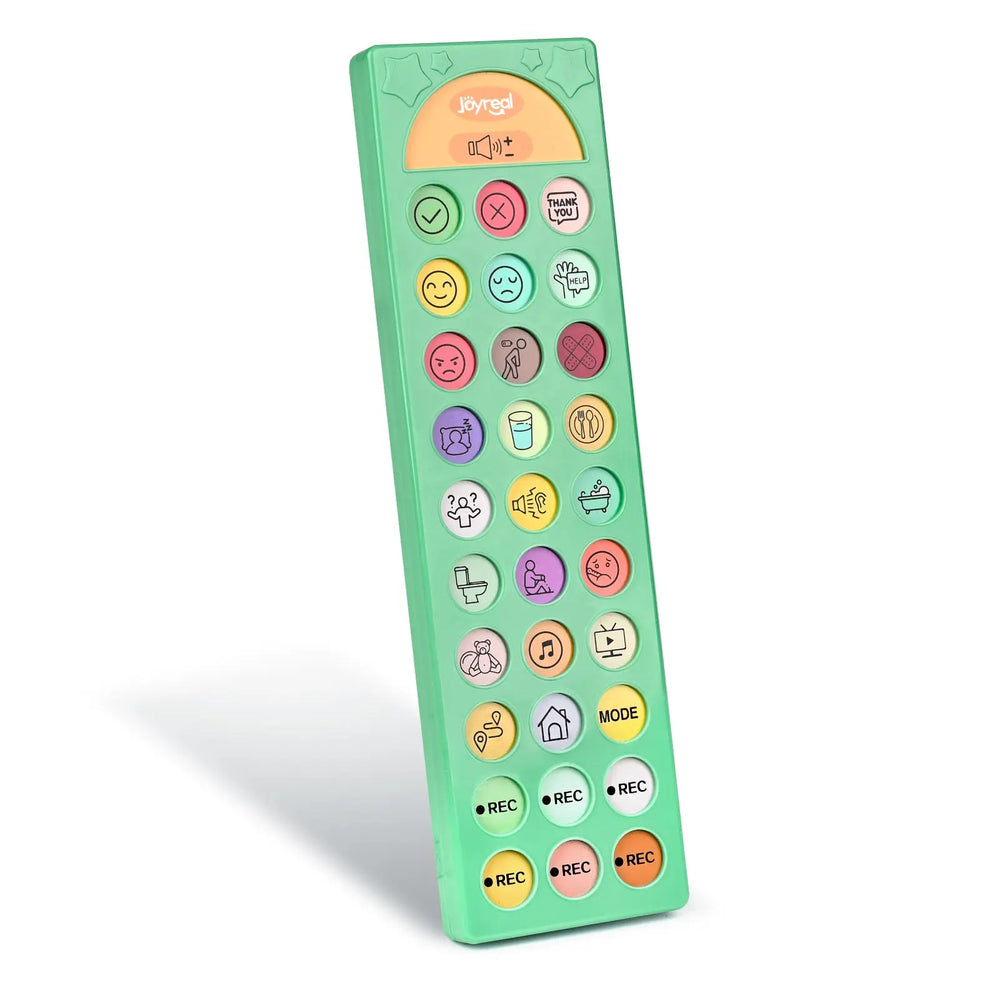
A Simple Home Support Option: Joyreal AAC
Many parents do not need a complex communication system on the first day. They need a practical way for their toddler to express everyday needs like “more,” “help,” “stop,” “eat,” “drink,” “all done,” “happy,” “sad,” or “break.”
Joyreal AAC is designed as a simple home communication support for autistic, nonverbal, minimally verbal, or speech-delayed children.
Parents can use it during meals, playtime, transitions, bedtime, or moments when a child needs a quick and clear way to communicate. It can be especially helpful for families who want to introduce basic communication before their child is ready for a more complex tablet-based AAC system.
Joyreal AAC is not a replacement for speech therapy, early intervention, or medical evaluation. Instead, it can be part of a communication-friendly home environment where a child has more than one way to be understood.

What Parents Should Remember
Early signs of autism in toddlers can look different from child to child.
Some children show speech delay.
Some show sensory needs.
Some show social differences.
Some show repetitive play or strong routines.
Some show big emotions because communication is difficult.
One sign alone does not define your child. But a pattern of signs is worth paying attention to.
If your toddler is not talking much, does not consistently respond to social cues, struggles with sensory experiences, or becomes frustrated because they cannot communicate, trust your instincts and ask for support.
Early support is not about rushing your child.
It is about meeting your child where they are.
And sometimes, the most important first step is simply giving your child a clearer way to say:
“I need help.”
“I want more.”
“I’m done.”
“I’m upset.”
“I want you to understand me.”
FAQ
Is Speech Delay Always A Sign Of Autism?
- No. Speech delay does not always mean autism. Some toddlers are late talkers or have speech delays for other reasons. However, speech delay combined with social differences, sensory needs, repetitive behaviors, or loss of skills may be a reason to seek developmental screening.
What Are Common Early Signs Of Autism In A 2-Year-Old?
- Common signs may include limited spoken words, not responding to name, reduced pointing or gestures, less eye contact, repetitive play, strong routines, sensory sensitivities, and difficulty with transitions.
What Are Common Early Signs Of Autism In A 3-Year-Old?
- Signs in a 3-year-old may include difficulty with back-and-forth communication, limited pretend play, trouble expressing needs, repetitive behaviors, sensory overwhelm, preference for playing alone, or distress when routines change.
Can A Toddler Have Speech Delay But Not Autism?
- Yes. A toddler can have speech delay without autism. The difference often depends on the broader pattern, including gestures, shared attention, imitation, play, sensory reactions, routines, and social communication.
Is Not Responding To Name Always Autism?
- No. Not responding to name can happen for different reasons, including hearing issues or attention differences. But if it happens often alongside speech delay, limited gestures, or social differences, parents should ask for screening.
Can Sensory Issues Be An Early Sign Of Autism?
- Yes. Some autistic toddlers have unusual reactions to sounds, textures, lights, smells, tastes, or movement. Sensory signs may appear as avoidance, overwhelm, or sensory-seeking behaviors.
When Should Parents Consider An AAC Communication Device?
- Parents may consider an AAC communication device when a toddler has needs, feelings, or choices but cannot reliably express them through speech. AAC can be explored alongside speech therapy, early intervention, and professional guidance.
Are AAC Devices For Autism Only For Nonverbal Children?
- No. AAC devices for autism can support nonverbal, minimally verbal, and speaking children who need help communicating needs, feelings, choices, or frustration. AAC is not only for children with no speech.
Summary
Early signs of autism in toddlers may include speech delay, sensory needs, social differences, repetitive play, strong routines, and frustration when communication breaks down. Speech delay alone does not always mean autism, but when several signs appear together, parents should seek professional guidance. Early support, speech therapy, visual routines, sensory accommodations, and AAC tools can help toddlers communicate more clearly and feel more understood.

Popular Guides for Parents
- DIY Busy Board: A Guide to Making Your Own
- Montessori Wooden Toys: Choose Baby Walking Toys to Boost Early Skills
- Montessori Busy Boards by Age: Safe, Skill-Building Toys for 10 Months to 4 Years
- How Do Different Colors Affect Sensory Overload in Autistic Children?
- Noah’s Ark Toy: Building Skills Through Play
- Best Busy Boards for 1 Year Old: A Parent’s Guide to Sensory Play
Recent Post

Wooden Musical Toys vs Electronic Music Toys: Which Is Better for Open-Ended Play?
For parents who want a calmer play environment, the choice between...

10 Simple Parent-Child Music Games Using a Toddler Drum Set
A toddler drum set can become much more than a noisy toy. With a fe...

Noah’s Ark Activities for Sunday School and Preschool
A Noah’s Ark toy can turn a familiar Bible story into a hands-on ac...

Noah’s Ark Toy Gift Guide: What Should Parents Check Before Buying?
A noah’s ark toy can be a thoughtful birthday, baptism, Christmas, ...

Can a Noah’s Ark Toy Be Used for Science and Nature Play?
Yes. A noah’s ark toy can be used as a starting point for simple sc...

How Can AAC Help a Child Communicate Pain, Illness, or Discomfort?
A child who cannot reliably use speech may still notice pain, illne...

How to Model AAC During Play Without Pressuring Your Child
For many children, play is one of the most comfortable places to pr...

How Can Parents Help a Child Use AAC at School and Home?
How Can Parents Help a Child Use AAC at School and Home? Children w...

AAC for Siblings and Playdates: Helping Children Join Social Play
Children do not need to use speech to take part in sibling play or ...

How to Teach Independent Play With a Busy Board Without Overhelping
Independent play does not usually begin with a parent stepping away...