
Is AAC A Device, An App, Or A Communication Method?
Quick Answer: AAC Is A Communication System
Many parents first hear the word AAC and picture a tablet, an app, or a speech device.
That makes sense. Those tools are often part of AAC. But AAC is bigger than one product.
AAC stands for Augmentative And Alternative Communication. It is a communication system that helps people express themselves when speech is difficult, limited, unclear, or not reliable.
For one child, AAC may look like pointing to pictures.
For another child, it may look like a tablet app.
For another, it may be gestures, signs, a simple board, or a speech-generating device.
ASHA explains that AAC may include no-tech, low-tech, and high-tech supports, and that children do not need to meet specific prerequisites before AAC is considered.
So the simplest answer is:
AAC is a communication method and support system. A device or app can be part of AAC, but AAC is not only the tool.

Why Parents Often Feel Confused
Parents often see words like AAC app, AAC device, speech-generating device, picture board, and communication board. These terms are related, but they do not all mean the same thing.
Some AAC options are digital, such as apps or speech-generating devices. Others are simple visual supports, such as picture cards, printed boards, gestures, signs, facial expressions, or body movements.
The tool matters, but it is only one part of communication.
A child also needs useful words, patient adults, daily modeling, and real chances to use AAC during everyday life.
What Is An AAC Device?
An AAC device is a tool that helps someone communicate without relying only on speech.
This can be simple or advanced. The National Institute On Deafness And Other Communication Disorders explains that AAC devices can range from a simple picture board to a computer program that creates speech from text.
In everyday family life, an AAC communication device may help a child share messages like:
“Help.”
“More.”
“Stop.”
“I’m hungry.”
“I need a break.”
“I’m all done.”
“That hurts.”
For autistic, nonspeaking, minimally speaking, or speech-delayed children, these small messages can make a big difference. They can reduce guessing, frustration, and meltdowns caused by not being understood.
What Is An AAC App?
An AAC app is software used on a tablet, phone, or computer to support communication.
Some apps use pictures or symbols.
Some use typed words.
Some speak messages out loud.
Some are simple, while others are more advanced and customizable.
An AAC app can be helpful, but not every child needs to start with an app. Some children do better with a simpler board, a dedicated device, picture cards, or a combination of supports.
The best AAC option is not always the most advanced one. It is the one your child can actually use, understand, and access during real moments.
Is AAC Only For Nonspeaking Children?
No. AAC is not only for children who do not speak at all.
AAC may also help children who:
- Say some words but cannot use them when upset
- Speak clearly at times but lose speech during stress
- Can label objects but cannot ask for help
- Have unclear speech
- Understand more than they can express
- Struggle to say “stop,” “hurt,” “break,” or “all done”
A child may be able to say colors, numbers, or animal names, but still not be able to communicate pain, fear, hunger, frustration, or a need for help.
AAC is not only about whether a child can talk. It is about whether the child can communicate reliably.
Does AAC Stop A Child From Talking?
This is one of the biggest worries parents have.
Many families wonder:
“If I give my child AAC, will they stop trying to speak?”
AAC is not meant to take speech away. It gives a child another way to communicate when speech is hard. ASHA’s early intervention AAC resources note that AAC does not hinder early speech development and can be introduced early.
Instead of seeing AAC as “giving up on speech,” parents can think of it as giving communication a backup path.
A child can use speech, sounds, gestures, pictures, signs, and devices together. The goal is not to force one way of communicating. The goal is to help the child be understood.
Signs Your Child May Benefit From AAC
Parents may consider AAC when a child has needs, thoughts, or feelings but cannot express them clearly.
Some signs include:
- Your child pulls your hand instead of using words.
- Your child cries or melts down when you do not understand.
- Your child says some words but cannot use them during stress.
- Your child has unclear or unreliable speech.
- Your child understands more than they can say.
- Your child struggles to communicate “help,” “stop,” “hurt,” or “break.”
- Adults often have to guess what your child wants.
These signs do not mean one specific tool is automatically right. They mean your child may need more ways to communicate.
A speech-language pathologist can help guide AAC choices when professional support is available.
How Parents Can Start AAC At Home
Starting AAC does not need to feel like a therapy session.
Begin with one routine and a few useful words.
At snack time, model:
“More.”
“Eat.”
“Drink.”
“All done.”
During play, model:
“Go.”
“Stop.”
“Again.”
“Help.”
During hard moments, model:
“Break.”
“Hurt.”
“No.”
“Finished.”
Modeling means you use the AAC word while speaking, without forcing your child to copy right away. ASHA recommends pointing to AAC symbols while talking during natural routines, much like adults naturally model spoken language for children.
Try not to turn AAC into a test.
Instead of saying:
“Say it.”
“Use your words.”
“Press the button first.”
Try saying:
“You want more.”
“You need help.”
“You are all done.”
“That was too loud.”
“You need a break.”
AAC works best when it feels useful, not pressured.

Where Joyreal AAC Can Fit
Joyreal AAC can be introduced as a simple home communication support tool for autistic, nonspeaking, minimally speaking, or speech-delayed children.
For families who are just beginning AAC at home, Joyreal AAC can offer a practical way to support everyday messages during real routines.
A child may use Joyreal AAC to express:
- More
- Help
- Stop
- Eat
- Drink
- All Done
- Break
- Happy
- Sad
Parents can use it during meals, playtime, bedtime, transitions, outdoor activities, and moments of frustration.
Joyreal AAC is not a replacement for speech therapy, autism assessment, school support, or professional guidance. Instead, it can serve as a simple starting point for families who want to make communication more accessible at home.
The goal is not to make AAC feel complicated. The goal is to help a child experience a clear connection between a message and a response:
“I asked for help, and someone helped me.”
“I asked for more, and someone understood.”
“I asked for a break, and my need was respected.”
That is how communication becomes meaningful.
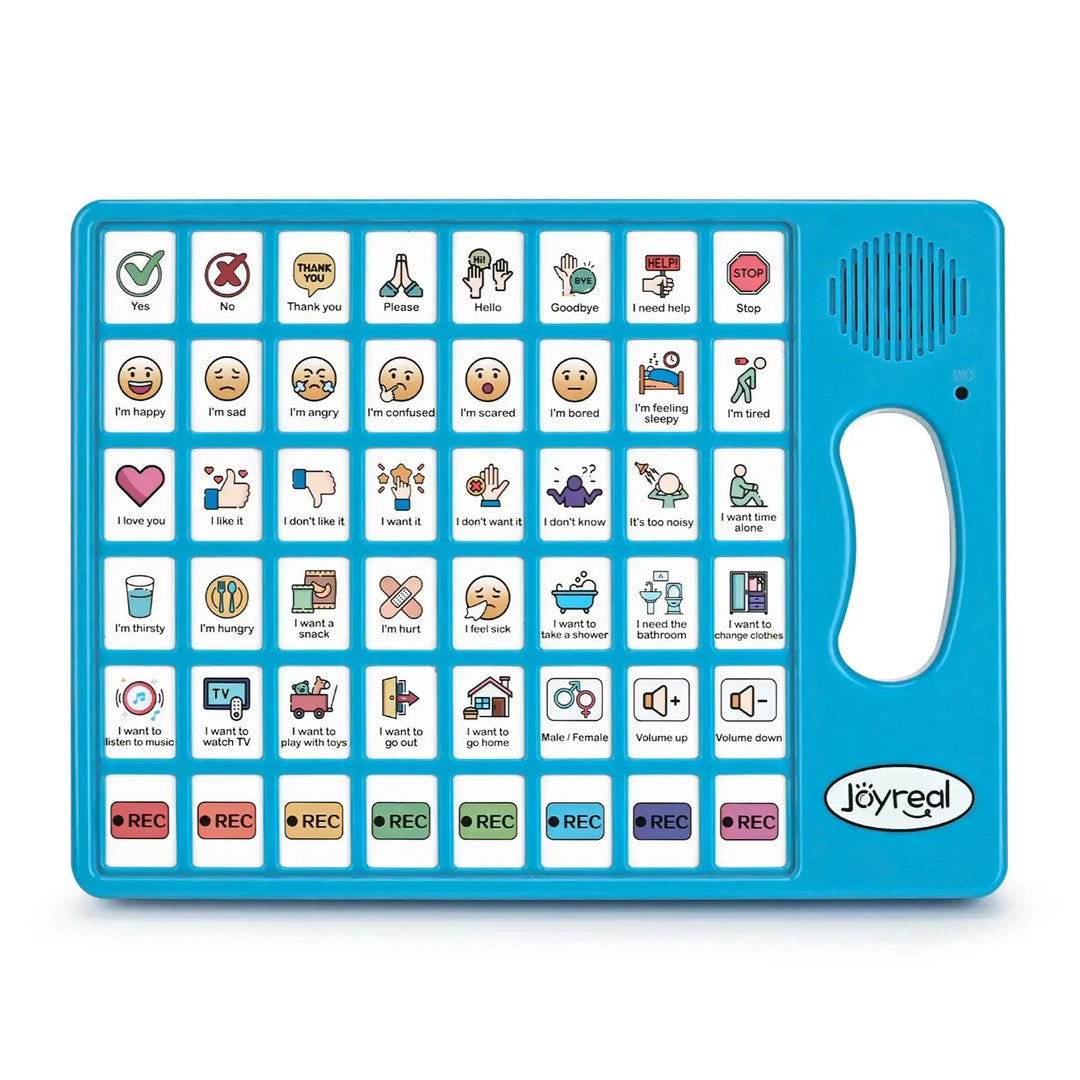
Best AAC device for kids
Plus AAC Communication
Board for Speech Support
$52.99 AT JOYREAL
54 reviews
Credit: Joyreal
What Parents Should Remember
AAC is not just a device.
It is not just an app.
It is not just a board of pictures.
AAC is a communication system that helps a child express needs, feelings, choices, refusal, and connection when speech alone is not enough.
For some children, AAC may look like a speech-generating device.
For others, it may look like picture cards, gestures, signs, or a simple communication board.
For many children, it may be a mix of different supports.
The tool matters, but the message matters more.
A child asking for help.
A child choosing more.
A child saying stop.
A child telling you they need a break.
Those are communication moments worth supporting.
FAQ
Is AAC A Device Or A Method?
AAC is a communication system. It may include devices, apps, picture boards, gestures, signs, writing, or other tools that help a person communicate.
Is An AAC App The Same As An AAC Device?
An AAC app is software used on a phone, tablet, or computer. An AAC device may refer to a physical communication tool, such as a picture board, button device, tablet-based system, or speech-generating device.
Can AAC Be Used For Autism?
Yes. AAC can support autistic children who are nonspeaking, minimally speaking, speech delayed, or unable to communicate reliably in daily situations.
Does AAC Stop Speech Development?
AAC is not designed to stop speech. It gives children another way to communicate and can be used alongside speech-language support.
What Is A Communication Device For Non Verbal Children?
A communication device for non verbal children is a tool that helps a child express messages without relying only on speech. It may use pictures, symbols, buttons, text, or voice output.
Where Does Joyreal AAC Fit In?
Joyreal AAC can be used as a simple home communication support tool for autistic, nonspeaking, minimally speaking, or speech-delayed children. It helps families practice everyday communication during meals, play, transitions, and moments of frustration.
Popular Guides for Parents
- DIY Busy Board: A Guide to Making Your Own
- Montessori Wooden Toys: Choose Baby Walking Toys to Boost Early Skills
- Montessori Busy Boards by Age: Safe, Skill-Building Toys for 10 Months to 4 Years
- How Do Different Colors Affect Sensory Overload in Autistic Children?
- Noah’s Ark Toy: Building Skills Through Play
- Best Busy Boards for 1 Year Old: A Parent’s Guide to Sensory Play
Recent Post

Wooden Musical Toys vs Electronic Music Toys: Which Is Better for Open-Ended Play?
For parents who want a calmer play environment, the choice between...

10 Simple Parent-Child Music Games Using a Toddler Drum Set
A toddler drum set can become much more than a noisy toy. With a fe...

Noah’s Ark Activities for Sunday School and Preschool
A Noah’s Ark toy can turn a familiar Bible story into a hands-on ac...

Noah’s Ark Toy Gift Guide: What Should Parents Check Before Buying?
A noah’s ark toy can be a thoughtful birthday, baptism, Christmas, ...

Can a Noah’s Ark Toy Be Used for Science and Nature Play?
Yes. A noah’s ark toy can be used as a starting point for simple sc...

How Can AAC Help a Child Communicate Pain, Illness, or Discomfort?
A child who cannot reliably use speech may still notice pain, illne...

How to Model AAC During Play Without Pressuring Your Child
For many children, play is one of the most comfortable places to pr...

How Can Parents Help a Child Use AAC at School and Home?
How Can Parents Help a Child Use AAC at School and Home? Children w...

AAC for Siblings and Playdates: Helping Children Join Social Play
Children do not need to use speech to take part in sibling play or ...

How to Teach Independent Play With a Busy Board Without Overhelping
Independent play does not usually begin with a parent stepping away...