
How Do I Communicate With A Nonverbal Autistic Child?
Communication Is More Than Speech
When a child does not use spoken words, it does not mean they have nothing to say.
Your child may already be communicating through eye gaze, body movement, facial expressions, sounds, gestures, pointing, pulling your hand, moving toward something, or moving away from something.
A child may bring you a cup because they are thirsty.
They may cover their ears because a sound is too loud.
They may push something away because they are finished.
They may cry because they are overwhelmed, not because they are trying to be difficult.
The first step is not forcing speech.
The first step is learning how your child already communicates.
Many parents ask, “How do I communicate with a nonverbal autistic child?” A helpful place to begin is with patience, observation, simple language, visual support, and more than one way for your child to express a message.
AAC, or Augmentative And Alternative Communication, can also support children whose speech is limited, unclear, or unreliable. ASHA describes AAC communication device as a way to support communication through gestures, signs, picture boards, speech-generating devices, and other tools.

Start By Watching The Message Behind The Behavior
Before adding new tools, pause and observe.
Communication may not always look like words. Sometimes it looks like a behavior that carries a message.
| What Your Child Does | What It May Mean |
| Pulls Your Hand | Wants help or wants you to follow |
| Pushes An Item Away | Does not want it or is all done |
| Covers Ears | The sound may be too loud |
| Cries During Transitions | Needs warning or visual support |
| Brings You An Object | Wants help, access, or attention |
| Moves Away | Needs space or wants something to stop |
| Reaches Toward Something | Wants that item or activity |
This does not mean every behavior has one fixed meaning. It means your child is giving clues. The more you notice patterns, the easier it becomes to respond with understanding.
Before trying to change how your child communicates, first show them that their message was heard.
Use Fewer Words And Give More Time
When a child is overwhelmed, too many words can make communication harder.
Instead of long explanations, try short, clear phrases:
“Shoes on.”
“Time to eat.”
“Want more?”
“Need help?”
“Take a break.”
“All done.”
After speaking, pause.
Some children need extra time to process what was said and decide how to respond. If adults repeat the question too quickly, add more words, or rush the child, communication may become more stressful.
A quiet pause gives your child time to look, point, gesture, vocalize, touch a picture, press a button, or respond in their own way.
Offer Choices Instead Of Open-Ended Questions
Open-ended questions can be hard.
Instead of asking:
“What do you want?”
Try offering two clear choices:
“Apple or cracker?”
“Car or blocks?”
“Music or quiet?”
“Outside or inside?”
Hold up the items if possible. Your child can answer by looking, reaching, pointing, touching, moving closer, or using AAC.
Choices reduce pressure because your child does not have to create a full answer from nothing. They only need a way to show preference.
Use Visual Supports During Daily Routines
Many autistic children understand better when they can see what is happening.
Visuals can make communication more concrete and reduce stress around transitions.
You can use:
- Real objects
- Photos
- Picture cards
- First/then boards
- Visual schedules
- Simple drawings
- Written words
- Communication boards
For example:
First shoes, then car.
First bath, then pajamas.
First clean up, then music.
Visual support is not only for learning. It can help your child understand what is happening now, what comes next, and what choices are available.
Respect Every Communication Attempt
Communication does not need to look perfect to be meaningful.
If your child points, that is communication.
If they hand you an object, that is communication.
If they pull away, that is communication.
If they use a sound, gesture, picture, or AAC button, that is communication.
Try to respond warmly when your child attempts to communicate.
If your child pushes food away, you might say:
“You’re all done.”
If they pull your hand toward a toy, you might say:
“You need help.”
If they cover their ears, you might say:
“That sound is too loud. Let’s take a break.”
This shows your child that their message matters.
Over time, feeling understood can make communication feel safer.
Introduce AAC Communication Device Without Pressure
AAC communication device can help when speech is not enough for daily communication.
It does not need to start with a complex system. It can begin with simple messages that matter in real life.
Useful first words may include:
- More
- Help
- Stop
- Eat
- Drink
- All Done
- Break
- Hurt
- Yes
- No
These words are powerful because they help a child ask, refuse, choose, protest, and express discomfort.
ASHA notes that there are no prerequisites for AAC intervention, which means a child does not need to prove they are “ready” before AAC is considered.
For families, this matters. You do not have to wait until everything is perfect before giving your child another way to communicate.
Model AAC Before Expecting Your Child To Use It
Modeling means you use the AAC tool while speaking, without forcing your child to copy immediately.
During snack time, you might point to or press “more” and say:
“More crackers.”
During play, you might model:
“Go.”
“Stop.”
“Again.”
During a stressful moment, you might model:
“Break.”
“Help.”
“All done.”
The goal is not to test your child.
The goal is to show them how communication works.
A child begins to learn:
“When this message is used, someone understands.”
That connection is what makes AAC meaningful.
Does AAC Stop A Child From Talking?
Many parents worry that AAC will stop speech from developing.
AAC is not meant to replace speech when speech is possible. It gives a child another way to communicate when spoken words are hard to use.
A child can use speech, sounds, gestures, pictures, signs, and AAC together. The goal is not to choose only one way to communicate. The goal is to help your child be understood.
Instead of thinking of AAC as giving up on speech, think of it as giving communication a backup path.
Where Joyreal AAC Talking Aid Can Fit
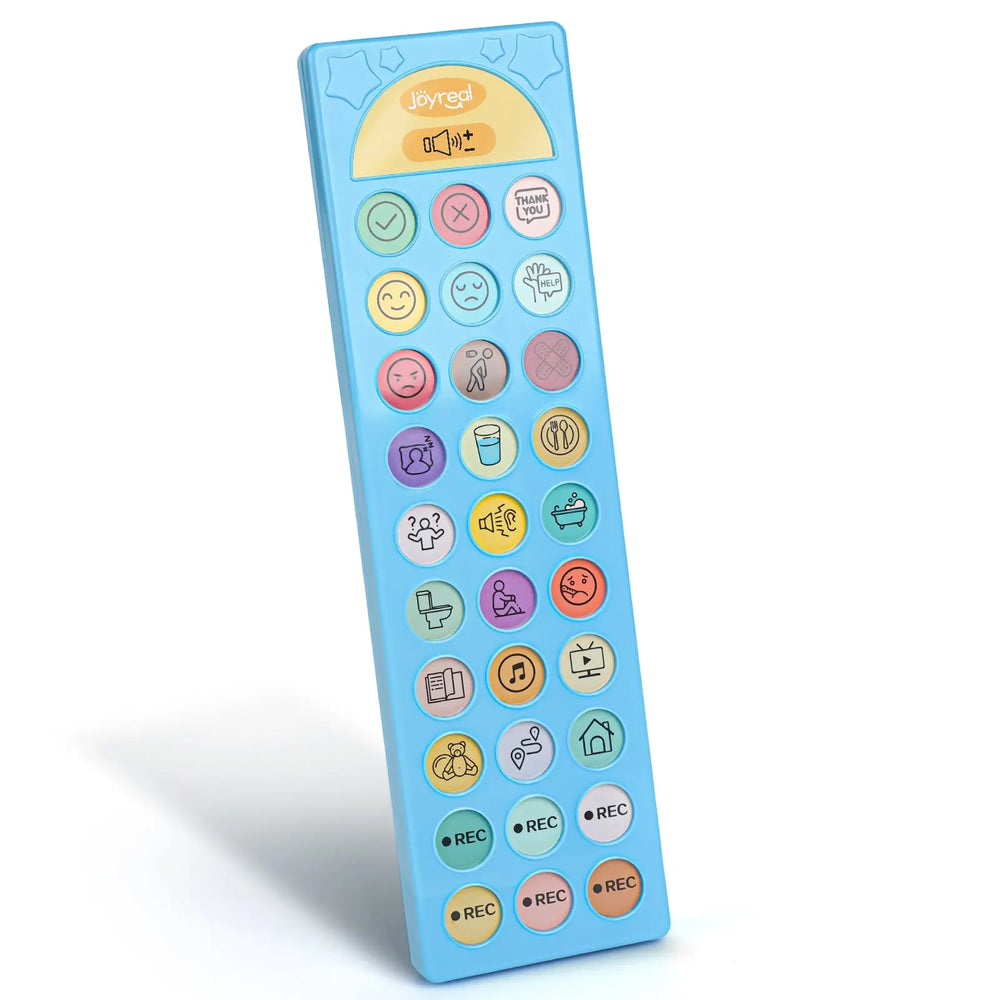
Joyreal talking aid can be introduced as a simple home communication support tool for children with limited speech, speech delay, or unreliable spoken communication.
For families beginning AAC at home, Joyreal AAC can help support everyday messages during real routines, such as meals, playtime, bedtime, transitions, outdoor activities, and moments of frustration.
A child may use Joyreal AAC to express:
- More
- Help
- Stop
- Eat
- Drink
- All Done
- Break
- Happy
- Sad
Joyreal AAC is not a replacement for speech therapy, autism assessment, school support, or professional guidance. Instead, it can serve as a simple starting point for families who want to make communication more accessible at home.
Start with one routine first.
For example, use it during snack time for “more,” “eat,” “drink,” and “all done.” Once your child becomes familiar with those messages, you can slowly introduce it during play, transitions, or moments when your child needs help.
The goal is not to make communication feel complicated.
The goal is to help your child experience:
“I asked for help, and someone helped me.”
“I asked for more, and someone understood.”
“I asked for a break, and my need was respected.”
That is how communication becomes meaningful.

What Parents Should Avoid
When communication feels difficult, parents may naturally feel desperate for progress. But pressure can make communication harder.
Try to avoid:
- Forcing eye contact
- Repeating “Say it” again and again
- Ignoring gestures or body language
- Taking away items until the child speaks
- Asking too many questions at once
- Assuming silence means no understanding
- Treating AAC as a last resort
Focus on connection first.
A calm child communicates more easily than a pressured child.
What Parents Should Remember
A child who does not speak still communicates.
Your job is not to turn every moment into a lesson.
Your job is to notice, respond, and offer more ways to be understood.
Start small.
Use fewer words.
Offer choices.
Watch body language.
Use visuals.
Model AAC.
Respect every communication attempt.
Speech is one way to communicate, but it is not the only way.
A child asking for help, choosing more, saying stop, or showing they need a break is sharing something important.
That message deserves to be heard.
FAQ
How Do I Communicate With A Nonverbal Autistic Child?
Start by observing how your child already communicates. Use short language, visual supports, simple choices, gestures, and AAC. Give extra time to respond and accept communication attempts that are not spoken words.
What Should I Say To A Child Who Does Not Speak?
Use short, clear phrases connected to real routines, such as “want more,” “need help,” “all done,” “time to eat,” or “take a break.” Avoid overwhelming your child with too many words at once.
Can A Child Understand Me Even If They Do Not Talk?
Yes. A child’s ability to speak is not the same as their ability to understand. Many children understand more than they can express, so it is important to speak respectfully and watch their responses.
Can AAC Help With Autism Communication?
Yes. AAC can give a child another way to express needs, choices, feelings, refusal, and discomfort. AAC may include picture boards, gestures, signs, speech-generating devices, or other communication tools.
What Is A Communication Device For Non Verbal Children?
A communication device for non verbal children is a tool that helps a child express messages without relying only on speech. It may use pictures, symbols, buttons, text, or voice output.
Where Does Joyreal AAC Fit In?
Joyreal AAC can be used as a simple home communication support tool for children with limited speech, speech delay, or unreliable spoken communication. It helps families practice everyday messages during meals, play, transitions, and moments of frustration.
Summary Of The Post
Communicating with a nonverbal autistic child begins with understanding that communication is more than speech. A child may use gestures, sounds, facial expressions, body movement, visuals, or AAC to express needs and feelings. Parents can support communication by using short language, offering choices, giving extra time, respecting all communication attempts, and modeling AAC during daily routines. Joyreal AAC can be introduced at home as a simple communication support tool while families continue seeking professional guidance.


Popular Guides for Parents
- DIY Busy Board: A Guide to Making Your Own
- Montessori Wooden Toys: Choose Baby Walking Toys to Boost Early Skills
- Montessori Busy Boards by Age: Safe, Skill-Building Toys for 10 Months to 4 Years
- How Do Different Colors Affect Sensory Overload in Autistic Children?
- Noah’s Ark Toy: Building Skills Through Play
- Best Busy Boards for 1 Year Old: A Parent’s Guide to Sensory Play
Recent Post

Wooden Musical Toys vs Electronic Music Toys: Which Is Better for Open-Ended Play?
For parents who want a calmer play environment, the choice between...

10 Simple Parent-Child Music Games Using a Toddler Drum Set
A toddler drum set can become much more than a noisy toy. With a fe...

Noah’s Ark Activities for Sunday School and Preschool
A Noah’s Ark toy can turn a familiar Bible story into a hands-on ac...

Noah’s Ark Toy Gift Guide: What Should Parents Check Before Buying?
A noah’s ark toy can be a thoughtful birthday, baptism, Christmas, ...

Can a Noah’s Ark Toy Be Used for Science and Nature Play?
Yes. A noah’s ark toy can be used as a starting point for simple sc...

How Can AAC Help a Child Communicate Pain, Illness, or Discomfort?
A child who cannot reliably use speech may still notice pain, illne...

How to Model AAC During Play Without Pressuring Your Child
For many children, play is one of the most comfortable places to pr...

How Can Parents Help a Child Use AAC at School and Home?
How Can Parents Help a Child Use AAC at School and Home? Children w...

AAC for Siblings and Playdates: Helping Children Join Social Play
Children do not need to use speech to take part in sibling play or ...

How to Teach Independent Play With a Busy Board Without Overhelping
Independent play does not usually begin with a parent stepping away...