
Why Are Canadian Parents Waiting So Long For Autism Support?
Waiting For Services Does Not Mean Doing Nothing
Many Canadian parents know the feeling.
You have noticed your child struggling.
You have asked questions.
You may be waiting for a referral, an autism assessment, speech therapy, occupational therapy, funding, or a service provider.
The waiting can feel discouraging. But waiting for formal autism support does not mean parents are powerless.
You do not have to replace professional services. You do not have to become a therapist overnight. But you can begin making daily life more understandable, more predictable, and more communication-friendly for your child.
The most helpful question is not only:
“When will support finally arrive?”
It is also:
“What can I do today to help my child feel understood?”
For families who are still waiting for assessment, therapy, or funding, small steps at home can still make daily routines easier. Learn more in our guide: What Canadian Parents Can Do While Waiting For Autism Support

Start By Observing Patterns At Home
Before appointments happen, parents can collect information that may help professionals later.
Try writing down what you notice in daily life:
- When does your child communicate most clearly?
- What triggers meltdowns?
- Which transitions are hardest?
- What sounds, textures, foods, or clothing bother your child?
- What activities calm your child?
- Does your child point, gesture, pull your hand, or use words?
- Does your child respond to their name?
- Does your child seem to understand more than they can say?
- What words or messages does your child need most often?
This is not about judging your child. It is about understanding patterns.
When you eventually meet with a pediatrician, speech-language pathologist, occupational therapist, or autism service provider, these notes can make the conversation more useful.
Ask For The Right Next Steps
Canadian parents may face different pathways depending on province, territory, and local resources. The Government of Canada’s Framework For Autism In Canada recognizes that screening, diagnosis, and services are delivered differently across jurisdictions, which can affect family access.
While waiting, parents can ask about:
- Developmental screening
- Hearing testing
- Speech-language evaluation
- Occupational therapy
- Early intervention programs
- Autism assessment pathways
- Parent coaching or local support groups
- School or daycare observations
Hearing testing is especially important when speech delay is part of the concern. A child may seem not to respond for several different reasons, and professionals can help rule out hearing-related issues.
Parents can also ask to be placed on cancellation lists when available. Some families may get appointments sooner if they are able to accept last-minute openings.
Use Visual Routines To Reduce Daily Stress
Many autistic children and children with developmental differences feel more secure when they know what is happening next.
Visual routines can help make the day more predictable.
These do not need to be complicated. Parents can use printed pictures, drawings, objects, or simple photos from the home.
Useful visual routines may include:
- Morning routine
- Getting dressed
- Mealtime
- Leaving the house
- Bath time
- Bedtime
- Daycare drop-off
- First/then boards
For example:
First shoes, then car.
First bath, then pajamas.
First clean up, then music.
A visual routine helps reduce the number of surprises in a child’s day. For some children, fewer surprises can mean fewer meltdowns.
Support Sensory Needs At Home
Many autistic children have sensory differences. Some are sensitive to sound, light, clothing, food textures, or touch. Others seek sensory input through jumping, spinning, climbing, chewing, or deep pressure.
Parents can begin by noticing what helps and what overwhelms the child.
At home, you might try:
- Reducing background noise
- Offering quiet breaks
- Cutting clothing tags
- Choosing softer fabrics
- Using predictable bath or haircut routines
- Offering crunchy or chewy foods if appropriate
- Creating a calm corner
- Giving advance warnings before transitions
- Allowing safe movement breaks
The goal is not to remove every challenge. The goal is to help your child feel safer in their body and environment.
When a child is overwhelmed, communication becomes harder. Supporting sensory needs can make communication support more successful too.
Why Communication Support Should Not Wait
For many families, communication is the hardest part of waiting.
A child may not be able to say:
- “I need help.”
- “I’m hungry.”
- “That hurts.”
- “I want more.”
- “I need a break.”
- “I’m all done.”
When speech is limited, unclear, or inconsistent, parents may see crying, pulling, grabbing, running away, or meltdowns. These behaviours are not always “bad behaviour.” Sometimes they are communication without reliable words.
This is why communication support should not wait until every appointment, diagnosis, or therapy plan is in place.
Families waiting for speech therapy or autism services may explore visual supports, picture cards, gestures, and AAC. An aac communication device can give children another way to express basic needs while professional support is still being arranged.
For autistic children, aac devices for autism and other communication devices for autism can make communication more concrete and predictable. For children with speech delay, aac devices for speech may support daily expression while spoken language continues to develop.
For a nonverbal or minimally verbal child, a simple communication device for non verbal children may help them express everyday words like “help,” “more,” “stop,” “eat,” “drink,” “break,” and “all done.”
AAC is not a replacement for diagnosis, therapy, or professional care. It is a practical way to reduce communication frustration while families wait for the next step. ASHA describes AAC as communication support that can include tools such as gestures, picture boards, speech-generating devices, and other strategies for people with speech-language difficulties.

Build Communication Into Daily Routines
Communication practice does not need to feel like homework.
It can happen during everyday moments.
At snack time, model:
“More.”
“Eat.”
“Drink.”
“All done.”
During play, model:
“Go.”
“Stop.”
“Again.”
“Help.”
During difficult moments, model:
“Break.”
“Hurt.”
“No.”
“Finished.”
Parents can support communication by using short phrases, repeating useful words, offering simple choices, and giving the child time to respond.
Instead of asking too many questions, try narrating what is happening:
“You want more crackers.”
“You need help.”
“You are all done.”
“That was too loud.”
“You want a break.”
This gives the child language for real experiences.
Choose First Words That Matter
If your child uses pictures, gestures, signs, or an AAC communication device, start with words that matter in daily life.
Good beginner communication words include:
- More
- Help
- Stop
- Go
- Eat
- Drink
- Open
- Play
- Again
- No
- Yes
- Break
- Hurt
- All Done
The best first words are not always polite words like “please” or “thank you.” Those can come later.
First, children need words that help them express needs, choices, feelings, and boundaries.
A child who can say “stop” has a safer way to protest.
A child who can say “help” has a clearer way to ask.
A child who can say “break” has a way to escape overwhelm without melting down.
Make Home More Communication-Friendly
A communication-friendly home does not need to be perfect.
It means your child has more than one way to be understood.
Parents can:
- Keep visual supports easy to reach
- Offer choices instead of open-ended questions
- Pause after speaking
- Accept gestures, pointing, sounds, or device use as communication
- Avoid pressuring the child to “say it”
- Model words naturally
- Celebrate attempts
- Use the same key words across routines
- Share communication strategies with grandparents, daycare, or siblings
Communication grows when the child learns:
“My message matters.”
Where Joyreal AAC Can Fit
Many Canadian parents are not looking for a complicated solution on the first day. They are looking for a simple way to help their child communicate during real home routines.
- Meals.
- Playtime.
- Bedtime.
- Getting dressed.
- Leaving the house.
- Transitions.
- Moments of frustration.
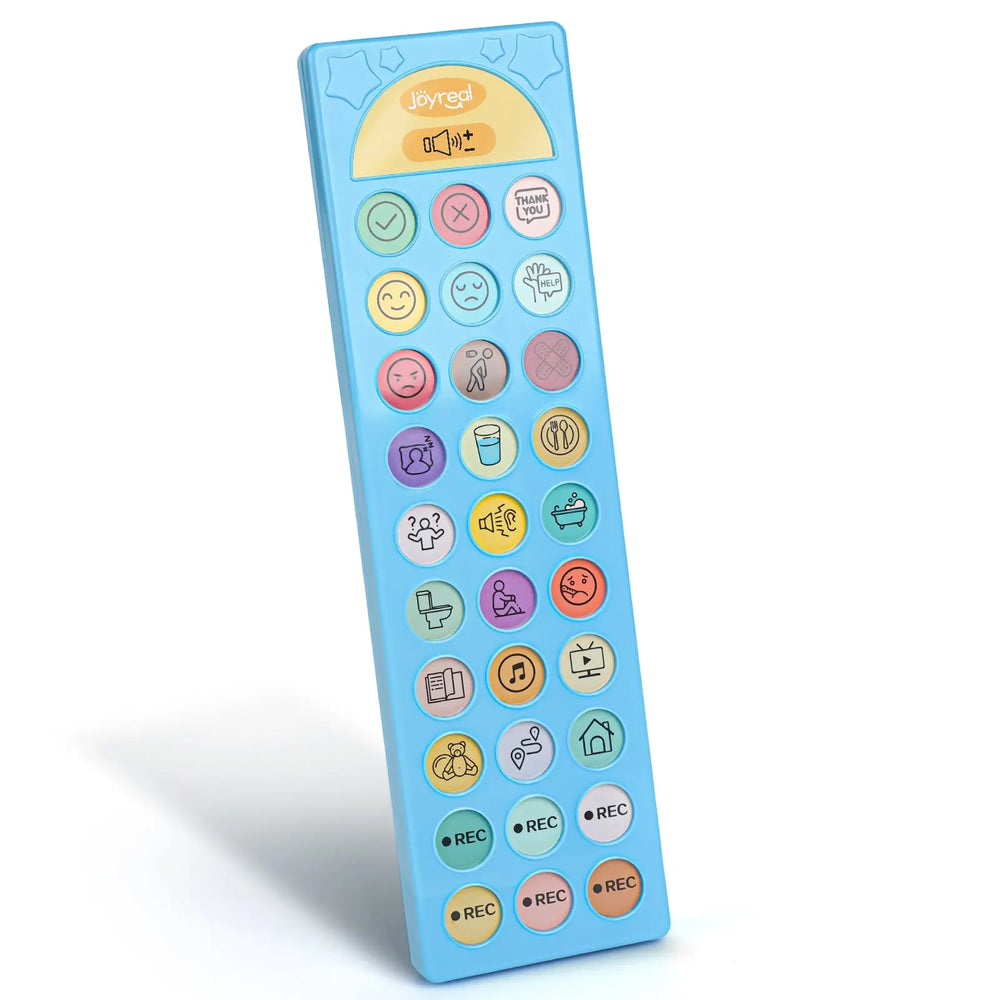
Joyreal AAC can be used as a simple home communication support tool for autistic, nonverbal, minimally verbal, or speech-delayed children. It helps families introduce practical everyday words such as “more,” “help,” “stop,” “eat,” “drink,” “all done,” and “break.”
For families waiting for autism support in Canada, Joyreal AAC can help bridge part of the daily communication gap. It does not replace speech therapy, early intervention, autism assessment, or professional guidance. Instead, it can support parents who want to give their child a clearer way to be understood at home.
This is especially relevant for families searching for an aac communication device, aac devices for autism, aac devices for speech, or a communication device for non verbal children while waiting for formal services.
How To Use Joyreal AAC During Everyday Moments
Joyreal AAC works best when it is used naturally, not only during practice time.
Parents can start with one routine at a time.
During snack time, model:
“More.”
“Eat.”
“Drink.”
“All done.”
During playtime, model:
“Go.”
“Again.”
“Help.”
“Stop.”
During transitions, model:
“Wait.”
“Break.”
“All done.”
“Help.”
The goal is not to force a child to use AAC perfectly. The goal is to help the child connect the device with real communication.
When a child learns that pressing or choosing “help” leads to being helped, AAC becomes meaningful.

What Parents Should Avoid While Waiting
Waiting can make parents feel desperate to do everything at once. But too much pressure can make communication harder.
Try to avoid:
- Forcing speech
- Turning every moment into a test
- Ignoring nonverbal communication
- Comparing your child to other children
- Waiting silently without asking for referrals
- Assuming no diagnosis means no support is needed
- Using AAC only during “practice time”
- Giving up if your child does not use a tool right away
Support works best when it is calm, consistent, and connected to real life.
When To Seek More Immediate Help
Parents should seek professional guidance if they notice loss of skills, major communication regression, safety concerns, severe feeding issues, significant sleep disruption, self-injury, frequent intense meltdowns, or any concern that feels urgent.
The Canadian Paediatric Society notes that children can sometimes be diagnosed by age 2, but many are not diagnosed until age 4 or 5, and diagnostic waits can be lengthy in many Canadian communities.
Parents do not need to wait until a child is older to raise concerns.
Early questions are valid.
What Canadian Parents Should Remember
Waiting for autism support can feel lonely, but waiting does not mean doing nothing.
You can observe.
You can ask for referrals.
You can build routines.
You can support sensory needs.
You can model simple language.
You can introduce visual supports.
You can explore AAC when speech is limited or unreliable.
Small supports at home do not replace professional care. But they can make today easier.
And for many children, one simple message can change the whole day:
“I understand what you are trying to tell me.”
FAQ
What Can Parents Do While Waiting For Autism Support In Canada?
Parents can track concerns, ask for referrals, request screening, contact local early intervention services, use visual routines, support sensory needs, and introduce communication supports at home.
Can AAC Help While Canadian Families Wait For Autism Services?
Yes. AAC may help children express basic needs while families wait for diagnosis, speech therapy, or autism services. It does not replace professional support, but it can reduce frustration and give children another way to communicate at home.
Are AAC Devices For Autism Only For Nonverbal Children?
No. AAC devices for autism can support nonverbal, minimally verbal, and speaking children who still struggle to express needs, feelings, pain, choices, or frustration.
When Should Parents Consider A Communication Device For Non Verbal Children?
Parents may consider a communication device for non verbal children when a child has needs, feelings, or choices but cannot reliably express them through speech. Families should also seek guidance from a pediatrician, speech-language pathologist, or early intervention provider.
Do AAC Devices For Speech Replace Speech Therapy?
No. AAC devices for speech do not replace speech therapy. They can support communication while families continue seeking professional guidance and therapy services.
How Can Joyreal AAC Support Families At Home?
Joyreal AAC can help families introduce simple everyday communication words during meals, play, transitions, and moments of frustration. It is a home communication support tool, not a replacement for professional therapy or diagnosis.


Popular Guides for Parents
- DIY Busy Board: A Guide to Making Your Own
- Montessori Wooden Toys: Choose Baby Walking Toys to Boost Early Skills
- Montessori Busy Boards by Age: Safe, Skill-Building Toys for 10 Months to 4 Years
- How Do Different Colors Affect Sensory Overload in Autistic Children?
- Noah’s Ark Toy: Building Skills Through Play
- Best Busy Boards for 1 Year Old: A Parent’s Guide to Sensory Play
Recent Post

Wooden Musical Toys vs Electronic Music Toys: Which Is Better for Open-Ended Play?
For parents who want a calmer play environment, the choice between...

10 Simple Parent-Child Music Games Using a Toddler Drum Set
A toddler drum set can become much more than a noisy toy. With a fe...

Noah’s Ark Activities for Sunday School and Preschool
A Noah’s Ark toy can turn a familiar Bible story into a hands-on ac...

Noah’s Ark Toy Gift Guide: What Should Parents Check Before Buying?
A noah’s ark toy can be a thoughtful birthday, baptism, Christmas, ...

Can a Noah’s Ark Toy Be Used for Science and Nature Play?
Yes. A noah’s ark toy can be used as a starting point for simple sc...

How Can AAC Help a Child Communicate Pain, Illness, or Discomfort?
A child who cannot reliably use speech may still notice pain, illne...

How to Model AAC During Play Without Pressuring Your Child
For many children, play is one of the most comfortable places to pr...

How Can Parents Help a Child Use AAC at School and Home?
How Can Parents Help a Child Use AAC at School and Home? Children w...

AAC for Siblings and Playdates: Helping Children Join Social Play
Children do not need to use speech to take part in sibling play or ...

How to Teach Independent Play With a Busy Board Without Overhelping
Independent play does not usually begin with a parent stepping away...