
AAC for Autistic Children: Supporting Play and Everyday Communication
When a child has difficulty using spoken language, everyday communication can become frustrating for the child and the people around them.
Parents may want to know what their child needs, wants, or feels. However, the words may not always be available when the child needs them most.
Augmentative and alternative communication, commonly called AAC, gives children additional ways to communicate when speech is difficult, unreliable, or unavailable. AAC can include gestures, facial expressions, signs, pictures, communication boards, visual schedules, buttons, tablet apps, and speech-generating devices.
For autistic children, AAC can support communication during play, meals, transitions, school activities, and family routines.

What Is AAC?
AAC is a communication system—not just an electronic device.
Some children use AAC alongside spoken language. Others may rely on AAC as their primary way to communicate. A child may also use different communication methods in different situations. For example, they might use speech at home, gestures during play, picture cards at school, and a speech-generating device when speech becomes difficult.
All of these communication methods can be meaningful.
Unaided AAC
Unaided AAC does not require an external tool. Examples include gestures, facial expressions, and body language.
Low-Tech AAC
Low-tech AAC uses simple physical materials, such as picture cards, communication boards, communication books, and objects.
High-Tech AAC
High-tech AAC may include single-message buttons, recordable communication devices, and tablets with AAC apps.
Does AAC Prevent Speech Development?
Current evidence does not show that AAC prevents or delays speech development. The American Speech-Language-Hearing Association (ASHA) states that AAC may support and even increase spoken language development when used as part of a multimodal communication approach. ASHA’s early intervention guidance notes that AAC does not hinder speech development.
A systematic review focused on children with autism found that AAC interventions did not impede speech production. Most of the studies reported increases in speech production, although the gains were modest and should not be guaranteed for every child. Read the systematic review on PubMed.
AAC may supplement spoken communication or provide an alternative when speech is unreliable or unavailable. Its purpose is to give children a reliable way to express wants, needs, refusals, feelings, questions, and ideas—not to replace speech or reduce motivation to communicate.
Why Might an Autistic Child Use AAC?
Some children understand more language than they can express through speech. Others may communicate through sounds, gestures, eye gaze, body movements, facial expressions, or actions.
When a child does not yet have a reliable way to communicate, they may cry, push objects away, leave an activity, drop items, or move toward something they want. These actions may communicate a request, protest, preference, feeling, or need for support.
AAC can give the child a clearer and more consistent way to express the same message.
For example, during play, a parent might pause before giving the child another turn. The child could use a picture, gesture, button, eye gaze, vocalization, or spoken word to communicate “more” or “again.”
This small interaction teaches the child that communication can influence what happens next.
How Can AAC Support Everyday Communication?
AAC does not need to be used only during speech therapy or structured learning. Everyday routines often provide meaningful opportunities for communication.
During play
Play is a natural place to introduce AAC because children are often motivated by the activity.
A cause-and-effect toy, busy board, building set, sensory activity, or pretend-play toy can create opportunities to model words such as: "Go", "More", ‘’Again“, ”Help".
A parent might pause before activating a toy and wait for the child to communicate “go” or “again.” The child can respond using any reliable communication method.
During meals
Mealtimes offer repeated opportunities to request, reject, and make choices.
Parents can model a few useful words, such as “more,” “help,” “drink,” or “finished,” while speaking naturally. The goal is not to turn every meal into a lesson. Children should have enough time to respond without pressure.
During daily routines
A visual schedule can show the steps of a routine. A child may point to “shoes,” “coat,” or “finished,” while a speech-generating device can speak the selected message aloud.
Predictable routines are helpful because children encounter the same actions and vocabulary repeatedly.

How to Introduce AAC Without Pressure
Follow Your Child’s Interests
Start with activities your child already enjoys. Motivation can make it easier for the child to participate and communicate.
If a child loves bubbles, model “more,” “open,” “go,” and “stop.” If they enjoy building blocks, model “help,” “again,” “fall,” and “my turn.”
Model While Speaking Naturally
Parents and caregivers can use the AAC system while talking to the child. This is sometimes called aided language modeling.
For example, while saying “Let’s open it,” the adult may select or point to “open” on the communication system.
The child does not need to copy the action immediately. Repeated exposure helps the child learn what the symbols, buttons, and words mean.
Pause and Wait
After offering a choice or starting an activity, pause for a few seconds.
Communication does not always happen through speech. A response may be a gesture, eye gaze, body movement, sound, picture selection, button press, sign, or spoken word.
Offer Choices
Choices make communication more concrete.
A parent might show two toys and ask:
“Blocks or animals?”
The child can point, touch, look toward one item, use an AAC symbol, sign, vocalize, or say a word. Accepting different forms of response helps the child learn that their preferences matter.
Respect All Communication
AAC should not be used to force a child to perform. Avoid requiring the child to repeat a message before receiving help, food, comfort, or access to an activity.
Responding meaningfully to communication attempts helps the child understand that communication is effective.
What If My Child Does Not Use AAC Right Away?
A child may initially:
- Ignore the device
- Press buttons repeatedly
- Use only one favorite message
- Need help accessing the tool
- Prefer gestures or pictures
- Use the tool differently than expected
This does not necessarily mean that AAC is unsuitable. The child may need more time, modeling, practice, or a different access method.
Keep the communication tool available during meaningful activities and avoid turning every interaction into a test. A speech-language pathologist or AAC specialist can help if the child continues to have difficulty accessing or using the system.
How Joyreal Toys Can Support AAC-Friendly Play
A simple turn-taking game can create a natural opportunity to use AAC at home.
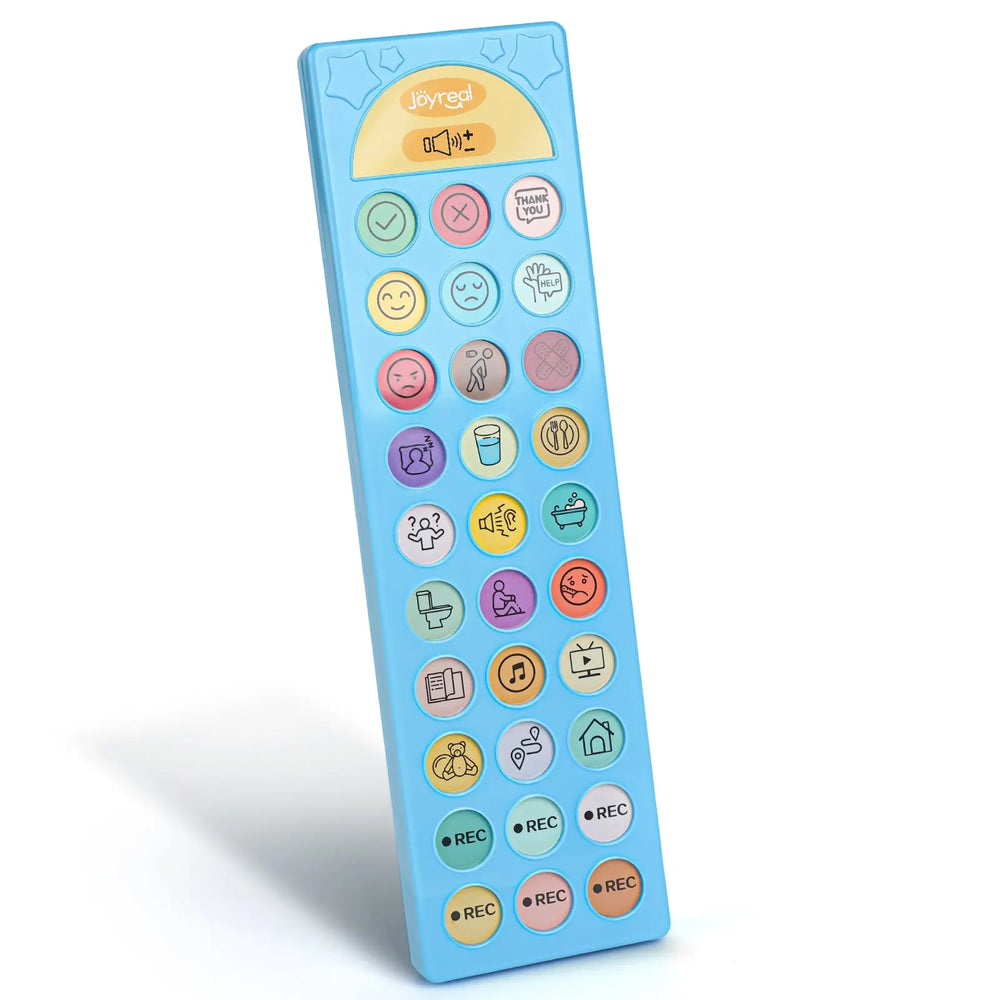
For example, while playing with a Joyreal toy, a parent can place the Joyreal Talking Aid AAC tool within the child’s reach and introduce a few functional messages, such as “go,” “more,” “help,” “again,” and “stop.”
The interaction might look like this:
- The parent activates the toy and then pauses.
- The parent points to or models “again” on the AAC communication board.
- The child responds by touching a message, pointing, looking toward the symbol, making a sound, signing, or speaking.
- The parent immediately responds by continuing the game.
- The parent models “stop” or “all done” when the activity ends.
The child does not need to use the tool perfectly or repeat the adult’s message. The goal is to show that communication can influence what happens next. Over time, this type of AAC-friendly play can give children repeated opportunities to request, make choices, take turns, ask for help, and comment on an enjoyable activity.

The Joyreal Talking Aid AAC tool is a consumer communication resource for introducing simple functional messages during play and everyday routines. It is not a replacement for an individualized AAC assessment. A speech-language pathologist or AAC specialist can help determine which communication system best matches a child’s language, motor, sensory, and access needs.
Frequently Asked Questions
Can AAC Help With Speech Development?
Current evidence does not show that AAC prevents or delays speech development. The American Speech-Language-Hearing Association states that AAC may support and even increase spoken language development when used as part of a multimodal communication approach. ASHA guidance.
Is AAC Only for Nonspeaking Autistic Children?
No. AAC may support nonspeaking, minimally speaking, and speaking autistic children.
A child may use AAC when speech is difficult to understand, becomes less reliable during stress or fatigue, or does not provide enough support for expressing complex thoughts. AAC can supplement spoken language rather than replace it.
When Can a Child Start Using AAC?
There is no required age, diagnosis, or speech milestone a child must reach before trying AAC. AAC can be considered whenever a child has difficulty communicating effectively.
A speech-language pathologist can help identify appropriate tools based on the child’s communication abilities, access needs, preferences, and everyday environments.
Who Can Help With AAC?
A speech-language pathologist can assess communication needs, recommend AAC options, develop vocabulary, and coach family members and educators.
Depending on the child’s needs, the AAC team may also include teachers, occupational therapists, physical therapists, special educators, developmental pediatricians, and assistive technology specialists.
Final Thoughts
AAC can make communication more accessible during play and everyday routines.
Start with your child’s interests. Model a few useful words, offer choices, pause for a response, and accept all reliable forms of communication.
A request, gesture, button press, eye gaze, sound, sign, or spoken word can all be meaningful communication.
AAC does not take away a child’s voice. It gives children more ways to be heard, understood, and included.
This article is for general educational purposes and is not a substitute for an individualized assessment by a qualified speech-language pathologist or AAC specialist.


Popular Guides for Parents
- DIY Busy Board: A Guide to Making Your Own
- Montessori Wooden Toys: Choose Baby Walking Toys to Boost Early Skills
- Montessori Busy Boards by Age: Safe, Skill-Building Toys for 10 Months to 4 Years
- How Do Different Colors Affect Sensory Overload in Autistic Children?
- Noah’s Ark Toy: Building Skills Through Play
- Best Busy Boards for 1 Year Old: A Parent’s Guide to Sensory Play
Recent Post

Wooden Musical Toys vs Electronic Music Toys: Which Is Better for Open-Ended Play?
For parents who want a calmer play environment, the choice between...

10 Simple Parent-Child Music Games Using a Toddler Drum Set
A toddler drum set can become much more than a noisy toy. With a fe...

Noah’s Ark Activities for Sunday School and Preschool
A Noah’s Ark toy can turn a familiar Bible story into a hands-on ac...

Noah’s Ark Toy Gift Guide: What Should Parents Check Before Buying?
A noah’s ark toy can be a thoughtful birthday, baptism, Christmas, ...

Can a Noah’s Ark Toy Be Used for Science and Nature Play?
Yes. A noah’s ark toy can be used as a starting point for simple sc...

How Can AAC Help a Child Communicate Pain, Illness, or Discomfort?
A child who cannot reliably use speech may still notice pain, illne...

How to Model AAC During Play Without Pressuring Your Child
For many children, play is one of the most comfortable places to pr...

How Can Parents Help a Child Use AAC at School and Home?
How Can Parents Help a Child Use AAC at School and Home? Children w...

AAC for Siblings and Playdates: Helping Children Join Social Play
Children do not need to use speech to take part in sibling play or ...

How to Teach Independent Play With a Busy Board Without Overhelping
Independent play does not usually begin with a parent stepping away...