
What Should Parents Do When a Child Does Not Want to Use AAC?
When a child does not want to use an AAC device, parents may wonder whether the device is too difficult or whether AAC is right for their child. In many cases, avoiding AAC does not mean a child does not want to communicate. The device may be unfamiliar, difficult to access, uncomfortable, or introduced with too much pressure.
The goal is not to make a child use AAC on command. The goal is to make communication easier, more meaningful, and available throughout the day. Whether your child uses a speech-generating device, picture board, or communication device for children, these low-pressure strategies can help.

First, Understand What “Refusing AAC” May Mean
A child may push away an AAC device, ignore it, throw it, or choose gestures, sounds, facial expressions, or body movements instead. These actions can communicate important information.
Your child may be saying:
- “I do not know how to use this.”
- “You are asking me to use it too often.”
- “The words I need are not available.”
- “I am tired, overwhelmed, or uncomfortable.”
- “I want to communicate in another way.”
- “This device is difficult to carry or reach.”
AAC should support communication—not replace every other form of communication. Gestures, facial expressions, vocalizations, signs, movements, and spoken words can all be meaningful. A child’s refusal is useful feedback. Instead of asking, “How do I make my child use AAC?” ask, “What is making communication harder right now?”
Do Not Turn AAC Into a Test
If a child is repeatedly told “Use your device,” “Tell me with AAC,” or “Press the button,” AAC can begin to feel like a test rather than a communication tool. This can be especially difficult during an autism morning routine, transitions, mealtimes, or community outings.
Instead of requiring an immediate response, model simple language on the device while continuing the activity. While getting dressed, you might model “shirt,” “help,” “different,” “stop,” or “finished.” Your child does not have to repeat the word immediately. The purpose is to show that the AAC device is available and useful.
Check Whether the AAC Device Is Easy to Use
Sometimes the problem is not motivation. The device may simply be difficult for the child to operate.
Is the device within reach?
If the AAC device is across the room, inside a bag, or kept on a high shelf, your child may not be able to use it when needed. Keep it available in the bedroom, kitchen, playroom, car, bathroom, backpack, and at the dining table.
Are the words easy to understand?
A child may not use a device if the vocabulary does not match daily needs. Include practical words and messages such as “help,” “more,” “no,” “stop,” “open,” “break,” “drink,” “hungry,” “hurt,” and “finished.” Children need ways to express refusal, discomfort, and personal preferences—not only requests.
Is the device physically comfortable?
Consider the size, weight, button layout, sound, screen brightness, and control sensitivity. Some children may dislike loud speech output, small buttons, too many choices, a bright screen, or a device that is difficult to hold. A simple AAC device may be easier to introduce in short, everyday interactions.
Start With Communication That Matters to Your Child
Children are more likely to use AAC when it helps them communicate something meaningful. Begin with situations where your child already shows a strong interest or need:
- Ask for a favorite snack
- Choose between two activities
- Request a preferred song
- Ask for help opening a container
- Say “more” during a favorite game
- Say “stop” when an activity is uncomfortable
- Choose pajamas at bedtime
- Request a break during a difficult task
If your child loves music, model “song,” “more,” “stop,” and “again.” If your child enjoys water play, model “water,” “pour,” “more,” and “finished.” The more directly AAC connects with a child’s interests, the more meaningful it becomes.
Use AAC During Daily Routines
AAC does not need to be used only during therapy sessions. Daily routines offer repeated opportunities for communication without creating a separate lesson. For more ideas, see our guides on AAC and morning routines for children with autism and making AAC part of daily routines.

During the morning routine
An autism morning routine may include many transitions. Your child may need to communicate “wake up,” “more sleep,” “bathroom,” “clothes,” “help,” “different,” “breakfast,” “drink,” “wait,” or “finished.” Model one or two words when they are relevant. While offering two shirts, model “choose” or “shirt.” When your child appears uncomfortable, model “help,” “stop,” or “different.”
During meals
Mealtimes offer natural opportunities to communicate “more,” “all done,” “drink,” “different,” “hot,” “cold,” “like,” “do not like,” and “help.” Do not require a child to use AAC before receiving food, water, or help. Communication should not become a barrier to meeting basic needs.
During play
Play is often a comfortable place to introduce AAC. Model “go,” “again,” “my turn,” “your turn,” “open,” “build,” “funny,” and “stop.” If your child does not use the device, continue through gestures, facial expressions, sounds, or actions. These attempts still matter.
Accept “No” as Valuable Communication
A child needs a reliable way to say no. “No,” “stop,” “finished,” “not that,” and “break” are as important as “more” and “I want.” If a child uses AAC to reject an activity, respect the message whenever possible. This teaches the child that the device has real power and that adults will listen.
- Offer a difficult activity.
- Model “try” and “break.”
- If the child communicates “stop,” pause when safe.
- Acknowledge: “You said stop.”
- Offer another option.
When children learn that AAC helps them escape discomfort, make choices, and set boundaries, they may become more willing to use it.
Model Without Expecting an Immediate Response
Parents do not need to wait for a child to use AAC before modeling language.

- Bring the device close.
- Select one or two useful words.
- Model while speaking naturally.
- Continue the activity.
- Wait briefly without demanding a response.
- Accept any communication attempt.
While playing with a toy car, for example, a parent might say “go” and press the matching button, then continue playing. A child may look at the device, reach toward the toy, make a sound, touch a button, smile, or move away. All of these responses provide information. Modeling demonstrates communication; it does not require imitation.
Give Choices Without Creating Pressure
Choices can make AAC more useful, but too many questions can be tiring. Instead of repeatedly asking “What do you want?” offer a simple choice: blocks or music, a blue shirt or red shirt, apple or banana, or more or finished.
Show both options, speak the words, and model the AAC message. Allow time for any response. If your child does not choose, make a reasonable decision and continue. The goal is to create opportunities—not a communication struggle.
Make AAC Part of the Family Environment
A child may be less likely to use AAC if only the child is expected to use it. Parents, siblings, teachers, and caregivers can model messages such as “I need help,” “More music,” “Finished,” “Let’s go,” or “I feel tired.”
This shows that AAC is a communication system, not a behavior chart. It also helps family members understand the device and respond consistently.
Consider Whether the Device Needs to Be Adjusted
If your child consistently avoids the AAC device, speak with a speech-language pathologist or another qualified professional. The device may need changes to vocabulary, button size, layout, voice output, access method, positioning, carrying system, visual design, or number of choices.
A child may benefit from more than one communication option. A speech-generating device may be useful in one situation, while a printed communication board or simple AAC talking aid may be easier in another. There is no single AAC device that works for every child.
A Simple Low-Pressure AAC Plan for Parents
Day 1: Observe
Notice when your child communicates most naturally. Look for gestures, sounds, movements, eye gaze, and actions.
Day 2: Choose five useful words
Select words connected to real routines, such as “help,” “more,” “stop,” “open,” and “finished.”
Day 3: Model during one preferred activity
Use the device during music, snack, bath time, or a favorite toy activity.
Day 4: Add a refusal word
Make sure your child can communicate “no,” “stop,” or “break.”
Day 5: Offer two choices
Present two meaningful options and accept any clear response.
Day 6: Use AAC during a routine
Try breakfast, getting dressed, leaving the house, or bedtime.
Day 7: Review what worked
Ask: When did my child look at or reach for the device? Which words were useful? Was the device available? Did I ask too many questions? Did my child have a way to refuse? What should be changed?
Small improvements are meaningful. AAC use does not have to be perfect to be helpful.

Introducing the Joyreal AAC Device
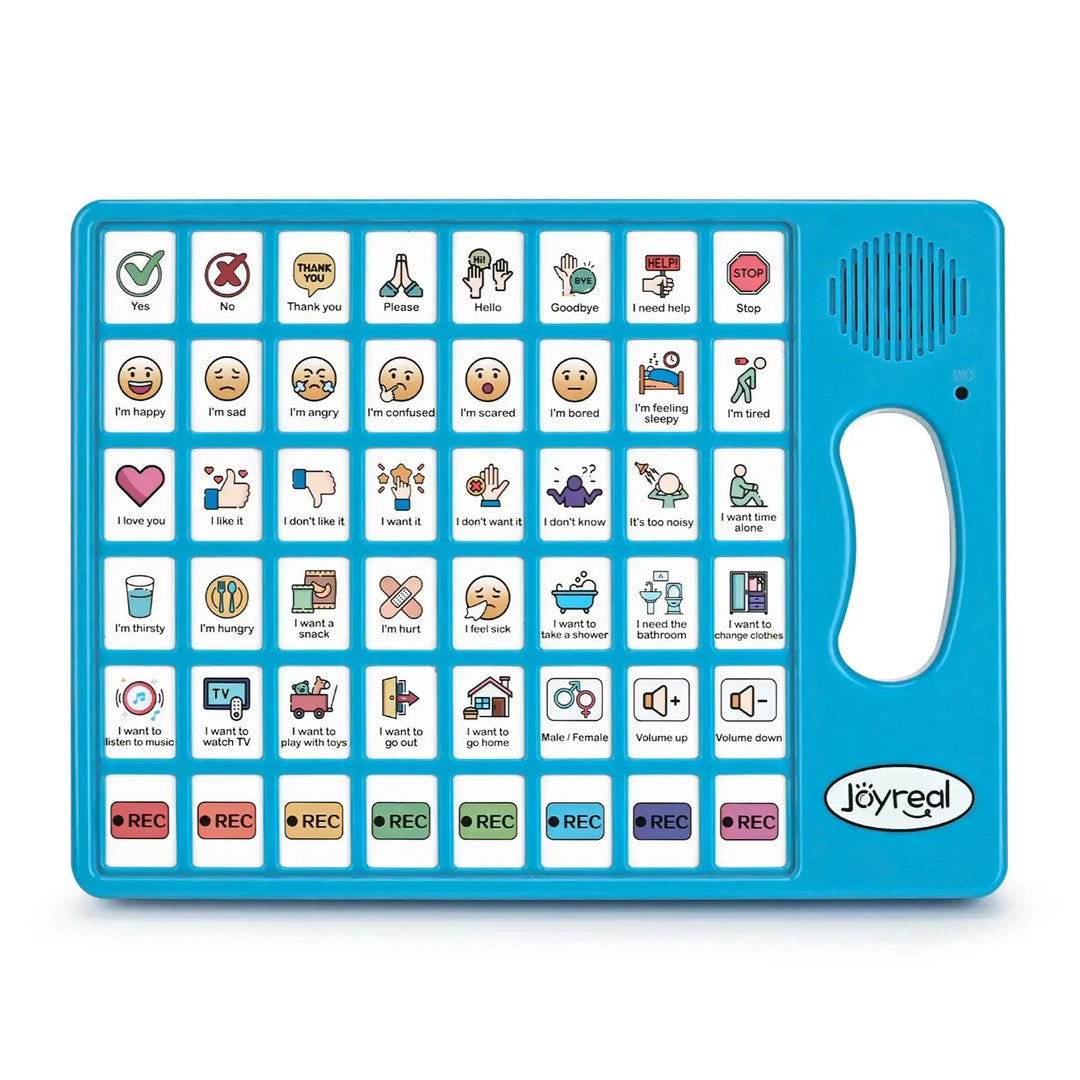
For families looking for a simple communication device for children, the Joyreal AAC Device and Joyreal AAC Talking Aid can provide an accessible way to practice short, functional messages during everyday activities.
Parents may introduce it during morning dressing, snack and mealtimes, toy selection, music play, bath time, bedtime, travel, or requests for help and a break.
The device should be offered as one communication option—not as a requirement before a child receives food, comfort, attention, or assistance.
Best AAC device for kids
Plus AAC Communication
Board for Speech Support
$52.99 AT JOYREAL
54 reviews
Credit: Joyreal
When Should Parents Ask for Professional Support?
Consider asking for professional guidance if:
- Your child cannot access the device physically.
- The device causes visible distress.
- Your child has no reliable way to communicate “no” or “help.”
- The vocabulary does not match daily needs.
- Communication difficulties are increasing.
- Family members respond inconsistently.
- You are unsure whether the device is appropriate.
- Your child may be communicating pain, illness, or sensory discomfort.
A speech-language pathologist can help evaluate communication needs and support an individualized AAC plan.
Final Thoughts
When a child does not want to use AAC, the answer is usually not to apply more pressure. Look for the reason behind the avoidance. Make the device easier to access, include words that matter, respect refusal, and model AAC during meaningful daily routines.
AAC should help a child communicate choices, needs, feelings, interests, and boundaries. When children learn that their communication is heard and respected, AAC can gradually become a more comfortable part of everyday life.
Frequently Asked Questions
Should I force my child to use an AAC device?
No. Forcing AAC can increase stress and make the device feel like a test. Model useful words, offer choices, and accept other communication methods while continuing to make AAC available. For a basic explanation of different options, read What Are AAC Communication Devices?
What if my child prefers gestures instead of AAC?
Gestures are meaningful communication. Continue responding to gestures while modeling AAC as an additional option.
Can AAC be used during an autism morning routine?
Yes. Morning routines provide natural opportunities to communicate about clothing, food, help, breaks, choices, and transitions. You can also read our guide to AAC during morning routines.
Should AAC only be used for requesting?
No. AAC can support refusal, commenting, social interaction, asking questions, expressing discomfort, making choices, and participating in daily activities.
Is a simple AAC device appropriate for every child?
No single device is right for every child. A simple AAC device may be useful for some children and situations, but families should consider individual needs and seek professional guidance when necessary.
AAC is an individualized communication support. This article provides general educational information and does not replace evaluation, treatment, or advice from a qualified speech-language pathologist or healthcare professional.
Popular Guides for Parents
- DIY Busy Board: A Guide to Making Your Own
- Montessori Wooden Toys: Choose Baby Walking Toys to Boost Early Skills
- Montessori Busy Boards by Age: Safe, Skill-Building Toys for 10 Months to 4 Years
- How Do Different Colors Affect Sensory Overload in Autistic Children?
- Noah’s Ark Toy: Building Skills Through Play
- Best Busy Boards for 1 Year Old: A Parent’s Guide to Sensory Play
Recent Post

Wooden Musical Toys vs Electronic Music Toys: Which Is Better for Open-Ended Play?
For parents who want a calmer play environment, the choice between...

10 Simple Parent-Child Music Games Using a Toddler Drum Set
A toddler drum set can become much more than a noisy toy. With a fe...

Noah’s Ark Activities for Sunday School and Preschool
A Noah’s Ark toy can turn a familiar Bible story into a hands-on ac...

Noah’s Ark Toy Gift Guide: What Should Parents Check Before Buying?
A noah’s ark toy can be a thoughtful birthday, baptism, Christmas, ...

Can a Noah’s Ark Toy Be Used for Science and Nature Play?
Yes. A noah’s ark toy can be used as a starting point for simple sc...

How Can AAC Help a Child Communicate Pain, Illness, or Discomfort?
A child who cannot reliably use speech may still notice pain, illne...

How to Model AAC During Play Without Pressuring Your Child
For many children, play is one of the most comfortable places to pr...

How Can Parents Help a Child Use AAC at School and Home?
How Can Parents Help a Child Use AAC at School and Home? Children w...

AAC for Siblings and Playdates: Helping Children Join Social Play
Children do not need to use speech to take part in sibling play or ...

How to Teach Independent Play With a Busy Board Without Overhelping
Independent play does not usually begin with a parent stepping away...